Rocky substrate band
Create a 3–5 cm wide band of coarse grit or small rocks around the plant crown to mimic its natural alpine habitat and improve drainage right where new rosettes form.

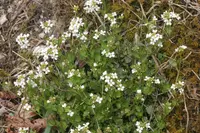
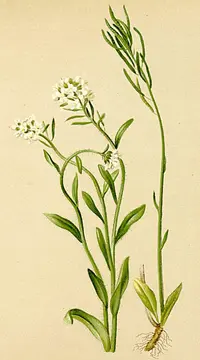
Arabidopsis halleri is a small, herbaceous perennial in the mustard family, often used as a model plant in scientific research. It forms low rosettes of simple leaves and sends up slender flowering stems with small white to pale lilac blooms.
In nature, it occurs mainly in central and southern Europe and is often found on rocky, metal-rich soils where many other plants struggle. It is generally hardy and resilient, though the tiny size of seedlings can make early growth more delicate.
This species favors bright light, cool to mild temperatures, and well-drained, moderately moist soil, which informs how to care for Arabidopsis in garden or research settings.

Care Difficulty
Moderate Care

Light Preference
Partial Sun

Water Requirements
Moderate Water

Temperature Preference
Cold Hardy

Hardiness Zone
4–8

Soil Texture
Sandy, Loamy, Rocky

Soil pH
Acidic (5.5–6.5), Slightly acidic (6.5–7.0)

Soil Drainage
Well-drained

Fertilization
Minimal (feed rarely)
Scan your plant to receive care tips personalized for your specific plant
Available on iOS and Android
This small rosette perennial prefers cool, bright conditions with some protection from harsh midday sun.
This species prefers consistently moist but not saturated soil, similar to seepage slopes or moist rocky sites.
This hardy species tolerates cool climates but grows best in moderate temperatures.
This species tolerates typical indoor humidity but grows best in slightly moist air.
Arabidopsis halleri prefers mineral, sharply drained, moderately fertile soil that never stays waterlogged.
This species can be grown in containers if the pot and substrate are chosen to keep roots aerated and free-draining.
This metal-tolerant wildflower usually needs little feeding in ordinary garden soil.
Pruning Arabidopsis halleri is minimal and mainly about hygiene and space management.
This species is more often transplanted in the garden than kept long term in containers.
New Arabidopsis halleri plants are most commonly raised from seed but can also be divided.
This cold-hardy perennial needs almost no special winter care in most temperate climates.

Plant Health Check
Not sure what's wrong with your plant? Check your plant's health inside the app.
Arabidopsis halleri is a hyperaccumulator that can store very high concentrations of zinc and cadmium in its leaves without showing toxicity symptoms, thanks to specialized metal transport and detoxification mechanisms.
This species naturally colonizes and thrives on heavy metal–polluted mine tailings and industrial soils where most other plants fail to establish, making it a useful model for understanding plant adaptation to pollution.
A. halleri is closely related to the genetic model Arabidopsis thaliana but is perennial and stress tolerant, so it is widely used to study how genomes evolve under strong environmental selection pressures such as metal toxicity and drought.

Arabidopsis halleri populations growing on metal-rich soils have independently evolved extreme metal tolerance multiple times, providing rare, replicated natural experiments that allow scientists to track the genetic basis of rapid adaptation in real time.
Yellowing leaves usually come from natural aging of lower foliage, nutrient deficiency (especially nitrogen), or prolonged water stress. Check drainage, avoid waterlogging, and consider a light, balanced fertilizer if the substrate is old or nutrient-poor.
Keep your plants happy and healthy with plant identification, disease detection, and easy care guidance.