Spring rosette cleanup
After winter, gently remove dead or mushy outer leaves from each rosette with clean fingers or small snips to improve air flow and reduce fungal issues as new growth starts.

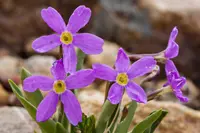
Alpine primrose, Primula angustifolia, is a compact, perennial flowering plant adapted to cool mountain environments. It forms low rosettes of narrow leaves topped with cheerful purple to violet blooms. Native to high-altitude regions of the western United States, it often grows in moist meadows, rocky slopes, and near snowmelt. The plant prefers cool conditions, consistently moist but well-drained soil, and protection from strong heat. It can be challenging in warm or dry climates, where maintaining cool roots and steady moisture is essential. Gardeners who learn how to care for alpine primrose usually find it rewarding in rock gardens, troughs, or other carefully controlled settings.

Care Difficulty
Hard Care

Light Preference
Full Sun

Water Requirements
Moderate Water

Temperature Preference
Cold Hardy

Hardiness Zone
3–7

Soil Texture
Sandy, Loamy, Rocky

Soil pH
Acidic (5.5–6.5), Slightly acidic (6.5–7.0)

Soil Drainage
Well-drained

Fertilization
Minimal (feed rarely)
Scan your plant to receive care tips personalized for your specific plant
Available on iOS and Android
This alpine perennial prefers cool, bright conditions with limited direct sun exposure.
Moist but not waterlogged soil is essential for healthy growth and flowering.
Cool, stable temperatures support strong growth and long-lasting flowers.
This species prefers cool, moderately moist air and reacts quickly to very dry conditions.
Primula angustifolia needs cool, moist, sharply drained soil that never becomes waterlogged.
This species can be grown in containers if moisture and drainage are controlled precisely.
This alpine primrose benefits from light, targeted feeding during its active growth but is sensitive to excess salts.
Primula angustifolia needs only light pruning focused on cleanliness and flower performance.
This species is usually grown in rock gardens or beds, so care focuses on careful transplanting rather than frequent repotting.
Primula angustifolia is commonly propagated by seed and careful division of mature clumps.
This alpine species is cold hardy but benefits from simple measures to stabilize winter conditions, especially in gardens with wet winters.

Plant Health Check
Not sure what's wrong with your plant? Check your plant's health inside the app.
This species is native to alpine and subalpine habitats of the southern Rocky Mountains, often occurring above treeline on windswept slopes and ridges where few broadleaf perennials can persist.
It forms tight, low cushions or mats of narrow, evergreen to semi-evergreen leaves, an adaptation that reduces heat loss and wind damage in harsh, exposed mountain environments.
Flowering typically occurs in a brief flush soon after snowmelt, allowing the plant to complete its reproductive cycle in the very short alpine growing season.

Primula angustifolia is considered regionally rare and is often associated with conservation concern in parts of its native range, because it depends on cold, high-elevation habitats that are especially sensitive to climate warming and changing snow patterns.
Lack of flowers usually comes from too-warm conditions, insufficient winter chill, or nutrient imbalance with too much nitrogen. Provide a cool dormant period, steady moisture, and a low-nitrogen, phosphorus-balanced fertilizer to support bud formation.
Keep your plants happy and healthy with plant identification, disease detection, and easy care guidance.