Rhizome division timing
Divide established clumps in early spring just as new shoots emerge, cutting the rhizomes into sections with at least 1 healthy bud each and replanting immediately at the same depth to expand your patch with minimal stress.

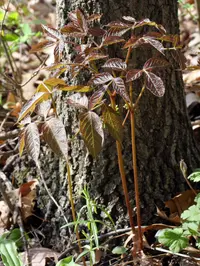
Wild sarsaparilla (Aralia nudicaulis) is a hardy woodland perennial native to forests of eastern and central North America. It spreads by underground rhizomes, forming low colonies under trees and shrubs.
The plant has umbrella-like clusters of divided leaves and produces small greenish-white flowers followed by dark purple berries. It typically grows in partial shade with cool, humus-rich, well-drained soil.
This species is adapted to natural woodland conditions and is generally forgiving if the soil stays evenly moist and not compacted. Gardeners who care for wild sarsaparilla should focus on providing stable shade and undisturbed, leaf-litter-style ground cover.

Care Difficulty
Moderate Care

Light Preference
Partial Shade

Water Requirements
Moderate Water

Temperature Preference
Cold Hardy

Hardiness Zone
3–8

Soil Texture
Loamy, Silty, Organic-rich

Soil pH
Acidic (5.5–6.5), Slightly acidic (6.5–7.0)

Soil Drainage
Moist but well-drained

Fertilization
Minimal (feed rarely)
Scan your plant to receive care tips personalized for your specific plant
Available on iOS and Android
This woodland perennial prefers bright, indirect light that mimics dappled forest shade.
Moist but not waterlogged soil suits this woodland species best.
This hardy perennial is adapted to cool to mild climates with cold winters.
This woodland perennial tolerates a broad humidity range but grows best with moderately moist air.
This species prefers loose, humus-rich forest-type soil that stays evenly moist yet drains freely.
This woodland plant can be grown in containers if the pot is deep and moisture is managed carefully.
Aralia nudicaulis is a woodland native that needs only light feeding in average garden soil.
Aralia nudicaulis needs minimal pruning, mainly to maintain health and tidy clumps.
Transplanting is more common than repotting, since this species is usually grown in the ground as a woodland plant.
Aralia nudicaulis is most commonly propagated by division of rhizomes rather than by seed.
This cold-hardy woodland species typically needs little special winter care in the ground.

Plant Health Check
Not sure what's wrong with your plant? Check your plant's health inside the app.
This species spreads mainly by underground rhizomes, forming large clonal patches where many aboveground stems are actually one genetic individual connected below the soil.
The spring flowers are visited by a range of insects, but it is particularly important for certain solitary bees and small flies that rely on early-season woodland nectar sources.
In North American mixed and boreal forests, it is often one of the dominant understory herbs, contributing to leaf-litter production and providing fruit for birds and small mammals.

Indigenous peoples across its native range have long used this plant as a medicinal and tonic species, and ethnobotanical studies cite it as one of the better-documented traditional remedies among North American woodland herbs.
This species spreads slowly by rhizomes, forming loose colonies over time rather than dense, choking patches. It usually coexists well with other woodland plants and is not considered aggressive in typical garden or naturalized settings.
Keep your plants happy and healthy with plant identification, disease detection, and easy care guidance.