Control Self-Seeding
Deadhead spent flower stalks before seed pods fully dry and turn brown, or bag a few seed heads only for dye seed-saving, to prevent this species from becoming invasive in open ground.

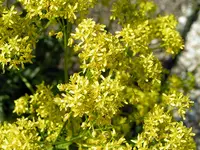
Dyer's woad, Isatis tinctoria, is a biennial or short-lived perennial herb historically used as a blue dye plant. It forms a rosette of bluish-green leaves in the first year, then sends up tall, branching flower stalks with many small yellow blooms in the second year. Seed pods turn dark and hang in clusters, giving the plant a distinctive look in late season. This species is native to parts of Europe and western Asia but is now naturalized in many temperate regions, sometimes behaving as an invasive weed. It grows readily in poor, dry, well-drained soils and full sun, so it is important to plan carefully if you choose to care for Dyer's woad.

Care Difficulty
Easy Care

Light Preference
Full Sun

Water Requirements
Low Water

Temperature Preference
Cold Hardy

Hardiness Zone
4–8

Soil Texture
Sandy, Loamy, Clay

Soil pH
Slightly acidic (6.5–7.0), Slightly alkaline (7.0–7.5)

Soil Drainage
Well-drained

Fertilization
Minimal (feed rarely)
Scan your plant to receive care tips personalized for your specific plant
Available on iOS and Android
This sun-loving dye plant thrives in bright, open conditions typical of temperate climates.
This hardy biennial prefers moderately dry, well-drained soil rather than constant moisture.
This cool-season species handles a wide temperature range but grows best in mild conditions.
Humidity is not a significant factor for Isatis tinctoria, which handles typical indoor and outdoor air well.
Isatis tinctoria grows best in moderately fertile, well-drained mineral soils.
This species can be grown in containers, though it is usually better suited to open ground.
Isatis tinctoria is a tough biennial that needs only modest feeding in average garden soil.
Pruning Isatis tinctoria focuses on tidiness and limiting unwanted self-seeding.
Transplanting this deep-rooted biennial requires careful handling to avoid disturbing its taproot.
Propagation of Isatis tinctoria is most reliable from seed under simple conditions.
This species is generally cold hardy and needs minimal winter care in most temperate climates.

Plant Health Check
Not sure what's wrong with your plant? Check your plant's health inside the app.
The leaves of this species were historically processed to produce a blue dye called woad, which colored textiles across Europe long before synthetic dyes and even before large-scale use of indigo from Indigofera species.
This plant is usually biennial, forming a low rosette of leaves in the first year and sending up tall flowering stems with yellow blossoms and many seed pods in the second year before dying.
Outside its native range in central and southwestern Asia, this species has become a noxious weed in parts of North America, where it spreads rapidly, displaces native vegetation, and is subject to legal control in several states.

Archaeological evidence shows that woad extracted from this species was used to dye textiles in Neolithic and Iron Age Europe, and it later became economically important again in medieval Europe before being displaced by imported indigo and modern synthetic dyes.
Poor flowering often comes from too much soil fertility, excessive shade, or plants crowded by competition. This biennial usually blooms in its 2nd year. Avoid heavy fertilizing and ensure plants are not overshadowed or stressed by drought.
Keep your plants happy and healthy with plant identification, disease detection, and easy care guidance.