


Host selection planning
Establish this hemiparasite only on compatible conifer hosts such as black spruce or white spruce in areas where those trees are not managed for timber or ornamental use, because removal of the host will kill the mistletoe.

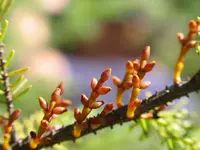
Eastern dwarf mistletoe (Arceuthobium pusillum) is a tiny parasitic flowering plant that lives on the branches of conifers, especially spruce and tamarack. It forms dense, yellowish to green shoots that emerge from swollen areas on host branches and often causes witches’ brooms, which are tangled clusters of distorted twigs.
This species is native to cool forests of northeastern North America, where it spreads by explosively discharged seeds. It is not suited to normal home cultivation, and attempts to care for eastern dwarf mistletoe are challenging because it depends almost completely on a living host tree for water and nutrients.
In nature it favors open, sunny to lightly shaded forest conditions and relies on the host tree’s root system rather than soil quality around the mistletoe itself.

Care Difficulty
Hard Care

Light Preference
Partial Shade

Water Requirements
Moderate Water

Temperature Preference
Cold Hardy

Hardiness Zone
2–6

Soil Texture
Loamy, Sandy, Organic-rich

Soil pH
Strongly acidic (4.5–5.5), Acidic (5.5–6.5)

Soil Drainage
Moist but well-drained

Fertilization
Minimal (feed rarely)
Scan your plant to receive care tips personalized for your specific plant
Available on iOS and Android
This parasitic shrub depends on host conifers, so light requirements focus on suitable canopy conditions rather than direct exposure to its own leaves.
Arceuthobium pusillum draws water from its conifer host, so moisture management targets soil around the host tree rather than the mistletoe itself.
This species is adapted to cold northern forests and relies on temperatures that its conifer hosts can tolerate.
Humidity is not a practical care factor because this species is an obligate parasite on living conifer hosts, not a conventional container or houseplant species.
Soil preparation is not typically relevant because Arceuthobium pusillum lives attached to host conifer tissues rather than rooted freely in substrate.
This species is not suitable for container growing because it requires a living conifer host and cannot be maintained as an independent potted plant.
This parasitic species extracts nutrients from its conifer host and does not benefit from direct fertilization.
Pruning for Arceuthobium pusillum focuses on host-tree health and limiting spread, not shaping the mistletoe itself.
Eastern dwarf mistletoe is almost never grown in containers; management focuses on when and how to remove or replace infected host trees.
Intentional propagation of Arceuthobium pusillum is not recommended in managed landscapes or home gardens because it is a damaging tree parasite.
This species is fully cold hardy in its native range and requires no targeted winter care beyond supporting overall host-tree health.

Plant Health Check
Not sure what's wrong with your plant? Check your plant's health inside the app.
This mistletoe builds up pressure inside its tiny fruits until they explosively eject seeds at high speed, allowing them to stick to nearby conifer needles and branches.
It mainly parasitizes black spruce and white spruce in boreal forests, tapping into the host’s xylem to steal water and minerals while doing very little photosynthesis itself.
Most of its body remains hidden inside host tissues; only small, broom-like shoots emerge, which helps it avoid harsh winter conditions in northern climates.

Eastern dwarf mistletoe is one of the few parasitic plants known to strongly influence forest fire behavior, because the dense witch’s brooms it induces in spruce trees can create dry, highly flammable fuel that alters how fires spread in boreal forests.
This species spreads very aggressively on suitable conifer hosts. It produces many tiny seeds that are explosively shot from fruits and stick to nearby branches, where they germinate and penetrate host tissues, gradually weakening and sometimes killing trees.
Keep your plants happy and healthy with plant identification, disease detection, and easy care guidance.

Lyreleaf Rockcress
Arabidopsis lyrata
Rocky Mountain blue columbine
Aquilegia saximontana
Giant Allium
Allium giganteum 'Globemaster'
Grey orchid
Vanda tessellata
Brazilian dwarf morning-glory
Evolvulus glomeratus
Swamp Rose-mallow
Hibiscus moscheutos
Pinguicula corsica
Pinguicula corsica
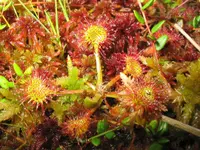
Roundleaf Sundew
Drosera rotundifolia