Mimic desert crust
Top-dress the planting area with a 2–4 cm layer of coarse, angular gravel to keep the crown dry, reduce soil splashing on leaves, and better mimic the rocky desert pavements this species naturally occupies.

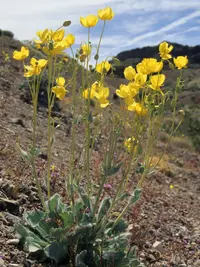
Arctomecon californicum, commonly called the Las Vegas bear poppy, is a small, perennial desert wildflower in the poppy family. It forms low rosettes of bluish gray, toothed leaves and sends up slender stems with showy, crepe-like white flowers and bright yellow centers.
This species is native to gypsum-rich desert soils in the Mojave Desert of Nevada and nearby areas, where it grows in sparse, open habitats. It is considered rare and sensitive in the wild.
The plant is adapted to harsh, dry conditions and can be difficult to establish in typical gardens, especially in humid or poorly drained climates. Successful growers focus on how to care for Arctomecon californicum by mimicking its natural, very well-drained, sunny, low-moisture environment.

Care Difficulty
Hard Care

Light Preference
Full Sun

Water Requirements
Low Water

Temperature Preference
Warm Climate

Hardiness Zone
8–9

Soil Texture
Sandy, Rocky

Soil pH
Neutral (7.0), Slightly alkaline (7.0–7.5)

Soil Drainage
Well-drained

Fertilization
Minimal (feed rarely)
Scan your plant to receive care tips personalized for your specific plant
Available on iOS and Android
This desert perennial requires strong, direct light to flower and stay compact.
This species is adapted to very dry desert conditions and is sensitive to excess moisture.
This species thrives in hot, dry climates but has limited tolerance to hard freezes.
This desert perennial thrives in very dry air and usually needs no humidity adjustment.
This species requires extremely fast-draining, mineral-rich soil that mimics desert gravel washes.
This species is challenging but possible to grow in containers when extreme drainage is provided.
This desert perennial is adapted to very lean soils and usually does best with no supplemental fertilizer.
Pruning needs for Arctomecon californicum are minimal and focus on hygiene rather than shaping.
Transplanting this native is challenging, as it resents root disturbance and prefers to remain where first established.
Propagation of Arctomecon californicum is specialized and usually left to conservation programs or experienced growers.
This species is adapted to cold desert winters and generally needs little targeted winter care in the landscape.

Plant Health Check
Not sure what's wrong with your plant? Check your plant's health inside the app.
This poppy is naturally restricted to a very small area of limestone gravel outcrops in the eastern Mojave Desert around Las Vegas, making it a narrow endemic with a highly fragmented distribution.
The species grows almost exclusively on light-colored, calcium-rich limestone pavements and colluvial slopes, where its pale foliage and taproot are adapted to high reflectance, low organic matter, and rapid drainage.
It has been listed as a threatened species under the U.S. Endangered Species Act since 1979 due to habitat loss, off-road vehicle use, invasive grasses, and urban expansion pressure.

Genetic and field studies show that individual populations of this species are often small and isolated, and the plant relies heavily on a long-lived soil seed bank with irregular germination events triggered by rare combinations of adequate rainfall and favorable surface disturbance.
This species usually flowers in spring, often from March to May, depending on local climate. Individual blooms are short-lived, typically a few days, but the plant can produce successive flowers over several weeks.
Keep your plants happy and healthy with plant identification, disease detection, and easy care guidance.