Rock crevice planting
Tuck the rootball slightly back into a rock crevice or between stones so the crown is shaded but the foliage gets full light, which reduces heat stress and mimics its natural alpine habitat.

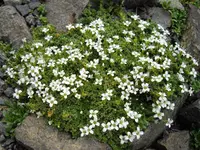
Arenaria tetraquetra is a compact, mat-forming alpine perennial, often used as a rock garden or crevice plant. It forms tight cushions of tiny, gray-green leaves that stay low to the ground. In late spring to early summer, it produces small white flowers that create a delicate, carpet-like display. The plant naturally occurs in rocky, mountainous regions of southern Europe, where it grows in shallow, well-drained soils. Its slow growth and preference for cool roots and sharp drainage can make it a bit demanding in warmer or humid climates. Gardeners who understand how to care for Arenaria tetraquetra usually find it reliable in rock gardens, troughs, or gravel beds.

Care Difficulty
Moderate Care

Light Preference
Full Sun

Water Requirements
Low Water

Temperature Preference
Cold Hardy

Hardiness Zone
4–8

Soil Texture
Sandy, Loamy, Rocky

Soil pH
Slightly acidic (6.5–7.0), Neutral (7.0)

Soil Drainage
Well-drained

Fertilization
Minimal (feed rarely)
Scan your plant to receive care tips personalized for your specific plant
Available on iOS and Android
This alpine cushion plant prefers cool, bright conditions with ample direct sun in most climates.
This species prefers slightly dry, sharply drained conditions that mimic rocky alpine slopes.
This hardy alpine thrives in cool to moderate temperatures and tolerates significant cold when well rooted.
This alpine cushion plant prefers relatively dry air and does not need elevated humidity indoors or outdoors.
This species needs sharply drained, gritty soil that mimics rocky alpine crevices.
This plant is suitable for container growing when mimicking a rocky, fast-draining environment.
This alpine cushion plant needs only light feeding in lean, well-drained soil.
Pruning needs for Arenaria tetraquetra are minimal and focus on maintaining a tight cushion.
This species is most often grown in rock gardens, so transplanting is more common than repotting.
New plants are most reliably produced by division or semi-ripe cuttings.
This alpine perennial is generally hardy in cold climates and needs little winter care in the ground.

Plant Health Check
Not sure what's wrong with your plant? Check your plant's health inside the app.
This species is native to high-elevation limestone and siliceous rock outcrops in the mountains of the Iberian Peninsula, where it grows in shallow crevices with very little organic soil.
It forms tight, dome-shaped cushions only a few centimeters tall, an adaptation that reduces exposure to cold winds and helps retain a more stable temperature near the plant surface.
The stiff, very small, triangular leaves are persistent and slow-growing, a trait that reduces water loss and suits the short growing season in its natural alpine habitats.
This species forms a very low, tight cushion that enlarges slowly over time. It does not usually spread aggressively. It may broaden to small mats, but edging or rock gaps easily keep it contained when growing Arenaria tetraquetra.
Keep your plants happy and healthy with plant identification, disease detection, and easy care guidance.