Florida adder's-mouth orchid Care (Malaxis spicata)

Also known as: Florida adder's-mouth

About Florida adder's-mouth orchid

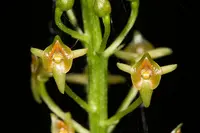
Florida adder's-mouth orchid (Malaxis spicata) is a small terrestrial orchid found in moist pine flatwoods, hammocks, and seepage areas in the southeastern United States and parts of the Caribbean. It produces a slender stem with small, greenish-yellow flowers arranged along a narrow upright spike above a few basal leaves.

This species has a delicate, somewhat understated appearance and a short blooming period, which can make it easy to overlook in the wild. It is considered challenging in cultivation because it relies on specific moisture and soil conditions and may associate with beneficial fungi in the root zone.

Those who want to learn how to care for Florida adder's-mouth orchid should know it prefers evenly moist, well-drained, humus-rich substrates and protection from intense direct sun.

Main Plant Requirements

Care Difficulty

Hard Care

Light Preference

Partial Shade

Water Requirements

Keep Soil Moist

Temperature Preference

Warm Climate

Hardiness Zone

9–11

Soil Texture

Loamy, Silty, Organic-rich

Soil pH

Acidic (5.5–6.5)

Soil Drainage

Moist but well-drained

Fertilization

Minimal (feed rarely)

Get Personalized Care Plan

Scan your plant to receive care tips personalized for your specific plant

Available on iOS and Android

How to Care for the Florida adder's-mouth orchid

This small terrestrial orchid prefers subdued forest light that mimics its native woodland habitat.

  • Provide bright shade or dappled light, such as under open trees, with brief early morning sun but no direct midday or afternoon sun.
  • Aim for filtered light equivalent to 2–4 hours of weak sun; stronger exposure can scorch leaves and dry the shallow roots of Florida adder's-mouth orchid.
  • In summer, protect from canopy gaps that create intense sun patches; in winter or early spring, slightly higher light is acceptable before trees fully leaf out.

This species prefers evenly moist but never waterlogged soil around its shallow root system.

  • Water when the top 1–2 cm of soil feels just barely dry, using observations of soil and foliage rather than a fixed schedule.
  • Ensure humus-rich, loose soil with excellent drainage so water drains within a few seconds yet the substrate stays slightly damp between waterings.
  • Reduce watering slightly in cooler months when growth slows, and watch for yellowing, limp leaves as a sign of overwatering or dull, folding leaves as a sign of drought stress in Malaxis spicata.

This orchid grows best in mild, frost-free conditions typical of shaded woodland floors.

  • Maintain ideal growing temperatures around 65–80°F (18–27°C), which support steady root and leaf development.
  • Protect the plant from frost; growth declines below about 50°F (10°C), and prolonged exposure near or below 32°F (0°C) can damage or kill underground parts.
  • During hot periods above 86°F (30°C), increase shade and soil moisture and avoid heat buildup from reflected surfaces to prevent stress and leaf scorch.

This terrestrial orchid needs moderately moist air to match its woodland habitat.

  • Aim for 50–70% humidity, as consistently lower than 40% often dries leaf edges and weakens growth in Florida adder's-mouth orchid.
  • In drier homes, group pots together or place the container on a pebble tray with water below, not touching the base.
  • Watch for curled, papery leaves or stalled new shoots as signs humidity is too low and watering alone is not sufficient.

Malaxis spicata prefers a loose, humus-rich substrate that mimics moist forest floor.

  • Use a fine-textured mix of 50% leaf mold or compost, 25% fine bark, and 25% perlite or pumice for aeration.
  • Ensure the mix stays evenly moist but never waterlogged; excess water should drain through within seconds, not sit on the surface.
  • Keep pH slightly acidic to neutral, around 5.5–6.8, avoiding strongly alkaline components such as heavy lime additions.
  • Avoid dense clay, pure peat, or straight garden soil, which compact easily, reduce root oxygen, and increase rot risk.

This species can be grown in containers if moisture and stability are managed carefully.

  • Choose a wide, shallow pot to match its relatively shallow root system and to keep the mix from staying wet in deep layers.
  • Select a plastic or glazed pot rather than unglazed clay if the local climate is hot and dry, to slow moisture loss from the sides.
  • Place the container in a sheltered position where wind cannot tip it, especially when tall flowering spikes develop.

Malaxis spicata is a small terrestrial orchid that benefits from very light, targeted feeding in active growth only.

  • Apply a weak balanced NPK orchid fertilizer at 1⁄4–1⁄2 strength every 4–6 weeks during spring–summer when shoots are expanding.
  • Use a dilute liquid or fine-grain slow-release product, keeping fertilizer off leaves and pseudobulbs to avoid scorch.
  • Florida adder's-mouth orchid growing in humus-rich, leaf-litter soils often needs no extra nutrients beyond this light feeding.
  • Stop feeding in autumn–winter dormancy and maintain only gentle, even moisture so salts do not accumulate around the roots.

Malaxis spicata needs minimal pruning, focused on hygiene rather than shaping.

  • In late summer or autumn, remove spent flower spikes at the base with small, sharp scissors once seed dispersal is complete.
  • Trim yellowed, dead, or clearly damaged leaves only, leaving green tissue to support photosynthesis and storage.
  • Disinfect cutting tools with alcohol before and between plants to reduce spread of fungal or bacterial diseases.
  • Avoid cutting healthy green shoots, as this compact orchid does not respond with fuller growth and flowering can be reduced.

This species is usually grown in the ground; any repotting or transplanting should be infrequent and gentle.

  • Plan transplanting for early spring, just as new shoots appear, so roots can re-establish quickly in warming soil.
  • Look for signs such as crowded clumps, declining vigor, or soil that breaks down and stays waterlogged before disturbing Malaxis spicata.
  • Move the plant with a wide soil plug, keeping roots and surrounding humus intact, and replant at the same depth in a loose, leaf-mold-rich mix.
  • Water lightly after planting, then keep evenly moist and shaded for 1–2 weeks to limit shock while new feeder roots grow.

Propagation of Malaxis spicata is specialized and usually left to experienced growers or conservation programs.

  • Division of established clumps in early spring is the most practical method, separating small sections with several healthy shoots and roots.
  • Replant divisions immediately into a fine, humus-rich, well-drained substrate, keeping them at the original depth and in bright, dappled shade.
  • Maintain high humidity, steady moisture, and mild temperatures during the first weeks so disturbed roots can recover.
  • Seed propagation requires sterile in vitro culture with a compatible fungus, so it is not recommended for typical home growers.

This terrestrial orchid is moderately cold tolerant but benefits from simple winter protection in many climates.

  • In regions with freezing winters, add a 3–5 cm layer of loose leaf mulch over the dormant area to insulate the roots.
  • Keep the planting site well drained, as cold, saturated soil increases the risk of root and rhizome rot.
  • Container-grown plants in colder zones can be moved into a cool, frost-free, bright location until consistent spring warmth returns.

Care Tips

Mesh pot setup

Grow plants in small mesh or slotted orchid pots nested inside a solid cachepot so roots enjoy constant airflow while the outer pot holds moisture around the fine root system.

Leaf litter mulch

Top-dress the medium with a very thin layer of shredded, pesticide-free hardwood leaves to mimic natural forest duff, stabilizing moisture and providing slow organic breakdown without smothering the rhizomes.

Cool-down trigger

Provide a slightly cooler, drier rest period for 6–8 weeks after flowering by reducing watering and dropping night temperatures by 5–10°F to encourage bud initiation for the next season.

Gentle division timing

Only divide clumps when new shoots are just emerging and can be separated with at least 2–3 healthy pseudobulbs each, then pot divisions immediately to prevent desiccation of the fine roots.

Subtle pest scouting

Inspect the undersides of leaves and the base of shoots every 1–2 weeks with a hand lens so scale, mites, or fungus gnats are caught early and managed before they disturb the delicate conditions needed for growing Florida adder's-mouth orchid.

Common Pests and Diseases

Spider mites

This pest thrives on thin, shaded foliage and can build up quickly in warm, still air, causing stippling and a dull, silvery look to the leaves. Symptoms include fine webbing along leaf undersides and around flower stems.

Solution

Increase humidity around the plant, gently rinse foliage with lukewarm water to remove mites and webbing, and repeat several times over 7–10 days. For persistent infestations, use a dilute insecticidal soap or horticultural oil directed mainly at the undersides of leaves, and improve air movement without creating strong drafts.

Scale insects

These insects attach along stems and leaf bases, sucking sap and weakening the small pseudobulbs and foliage. Symptoms include sticky honeydew, sooty mold growth, and raised brown or tan bumps that do not rub off easily.

Solution

Remove heavily infested stems or flower spikes and wipe remaining colonies with cotton swabs dipped in isopropyl alcohol, taking care not to saturate the roots. Follow up with targeted applications of insecticidal soap on new crawlers and inspect the plant weekly until no new scale appears.

Orchid fungal leaf spots

This disease appears as small, water-soaked spots on the thin leaves that turn brown or black and may coalesce under persistently damp, shaded conditions. Symptoms include irregular lesions that can cause premature leaf drop if humidity stays high with poor airflow.

Solution

Remove affected leaves or cut out damaged sections with a sterile blade, then keep foliage dry and avoid overhead watering late in the day. Improve air circulation around the plant and, in severe or spreading cases, use a labeled fungicide for ornamental orchids, applying lightly and allowing the plant to dry quickly.

Slugs and snails

These pests are attracted to the moist, organic substrates and shaded sites typically used for growing Florida adder's-mouth orchid, chewing holes in leaves and tender flower spikes. Symptoms include ragged edges, missing tissue, and slime trails on pots or media surfaces.

Solution

Hand-pick slugs and snails at night or early morning and use physical barriers such as copper tape around benches or pots. If damage continues, apply iron phosphate slug pellets sparingly around, not on, the potting area and reduce dense ground litter where they hide.

Rhizoctonia root and stem rot

This disease affects the fine roots and basal stems in constantly wet or poorly aerated mixes, leading to yellowing leaves and a gradual collapse of the small plant clumps. Symptoms include brown, mushy roots and decaying stem bases where the orchid contacts the medium.

Solution

Remove the plant from its container, trim out all brown and soft tissue, and repot into a fresh, free-draining, fine orchid mix or very loose terrestrial orchid substrate. After repotting, water lightly until new root growth appears, avoid waterlogged conditions, and disinfect tools and old containers to prevent reintroduction of the fungus.

Interesting Facts

Tiny terrestrial orchid

This species is a small ground-dwelling orchid native to Florida and parts of the Caribbean, often only a few cm tall and easy to overlook among leaf litter and low vegetation.

Spiral flower arrangement

Its yellowish-green flowers are arranged in a slender, densely packed spike, with each small flower subtly twisted, a morphology that helps distinguish it from other inconspicuous woodland orchids.

Specialized habitat preference

It typically grows in moist, shaded habitats such as hammocks and forest edges on calcareous or organic-rich soils, making it sensitive to drainage changes and habitat disturbance.

FAQs about Florida adder's-mouth orchid

This species usually flowers in late spring to mid-summer, depending on local climate and moisture. Flowering often coincides with warm, humid weather and stable soil moisture, and individual flower spikes are modest but quite distinctive at close range.

Grow Healthy Plants with Botan Care

Keep your plants happy and healthy with plant identification, disease detection, and easy care guidance.

Botan plant care app — identify plants on mobile

Explore More Plants