Use low-nutrient sites
Choose poor, gravelly, or disturbed ground where competition is low, as richer soils encourage aggressive growth of surrounding plants that quickly shade this species out.

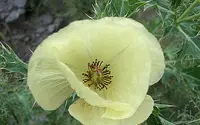
Argemone subfusiformis is a spiny annual or short-lived perennial herb in the poppy family, known for its pale, crepe-like flowers and prickly gray-green foliage. It forms a clumping habit with branching stems and distinctive seed pods armored with sharp spines.
This species is native to arid and semi-arid regions of Mexico and the southwestern United States, where it often colonizes disturbed, dry, and sandy sites. It is generally easy to grow for gardeners who can provide full sun, well-drained poor soil, and minimal watering.
Because it thrives on neglect and resents overly rich or wet conditions, it suits low-maintenance, xeric-style plantings. Understanding how to care for Argemone subfusiformis mainly involves respecting its drought-adapted nature and sharp spines.

Care Difficulty
Easy Care

Light Preference
Full Sun

Water Requirements
Low Water

Temperature Preference
Warm Climate

Hardiness Zone
8–11

Soil Texture
Sandy, Loamy, Rocky

Soil pH
Slightly acidic (6.5–7.0), Slightly alkaline (7.0–7.5)

Soil Drainage
Well-drained

Fertilization
Minimal (feed rarely)
Scan your plant to receive care tips personalized for your specific plant
Available on iOS and Android
This sun-loving desert annual thrives in bright, open sites with long daily exposure.
This species is drought-tolerant and prefers infrequent, light watering once established.
This heat-adapted annual performs best in warm, arid to semi-arid conditions.
This desert-adapted species tolerates very low humidity and rarely needs special humidity management.
This species needs mineral, sharply draining soil that mimics dry, rocky habitats.
This species can be grown in containers if the pot is set up to stay dry and free-draining.
This desert annual typically needs no fertilizer in lean, well-drained soil.
Pruning needs for Argemone subfusiformis are minimal and focus on safety and tidiness rather than shaping.
This species is rarely kept as a long-term container plant and dislikes disturbance once established outdoors.
Propagation of this species is done almost entirely from seed rather than vegetative methods.
This annual desert poppy completes its life cycle in one season and normally needs no special winter care.

Plant Health Check
Not sure what's wrong with your plant? Check your plant's health inside the app.
This species is native to arid and semi-arid regions of Mexico, where it commonly colonizes disturbed, sandy, or gravelly soils along roadsides and fallow fields.
Its fruiting capsules are covered with sharp spines and contain a yellowish latex and numerous seeds, an adaptation that helps deter herbivores and facilitates seed dispersal when the capsules split.
The plant produces pale yellow to whitish, crinkled petals with a dark central eye and a prominent ring of bright yellow stamens, a typical poppy-family structure that is especially attractive to bees in its native range.
This species self-seeds freely and can spread quickly in open, disturbed, or dry sites. In suitable climates it may behave weedy. Deadhead spent flowers before seed set and remove unwanted seedlings to keep it contained.
Keep your plants happy and healthy with plant identification, disease detection, and easy care guidance.