Formative crown training
In the first 3–5 years, select a single strong leader and 4–6 evenly spaced scaffold branches, removing competing shoots in late winter to build a stable, open crown that resists storm damage.

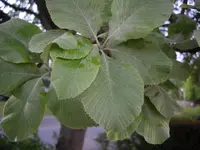
Whitebeam (Aria edulis) is a small to medium-sized deciduous tree, valued for its broad, rounded crown and clean, structured look in landscapes. It belongs to the rose family and is related to rowans and service trees.
Leaves are dark green above and distinctly pale, almost white, beneath, giving the canopy a silvery appearance in wind. Clusters of white spring flowers are followed by small, red berries.
Aria edulis is native to parts of Europe and favors sunny sites with well-drained, often chalky or limestone soils. It is generally hardy and tolerant of urban conditions, so it suits gardeners who want a resilient tree and need simple guidance on how to care for Whitebeam.

Care Difficulty
Moderate Care

Light Preference
Full Sun

Water Requirements
Moderate Water

Temperature Preference
Cool Climate

Hardiness Zone
5–7

Soil Texture
Loamy, Sandy, Clay

Soil pH
Slightly acidic (6.5–7.0), Slightly alkaline (7.0–7.5)

Soil Drainage
Well-drained

Fertilization
Minimal (feed rarely)
Scan your plant to receive care tips personalized for your specific plant
Available on iOS and Android
This species prefers full sun exposure but tolerates light shade in warmer regions.
This tree prefers evenly moist, well-drained soil and does not tolerate prolonged waterlogging.
This hardy species suits cool to temperate outdoor climates with cold winters and mild to warm summers.
This species is naturally tolerant of relatively dry air and humidity is rarely a limiting factor outdoors.
Aria edulis prefers moderately fertile, well-structured mineral soil that drains freely yet retains some moisture.
This species can be grown in large containers for a limited period, provided root space and stability are carefully managed.
Aria edulis, often known as Whitebeam, benefits from light feeding rather than heavy fertilization in typical garden soil.
Aria edulis responds well to modest structural pruning that maintains a strong framework and safe size.
This species is typically grown in the ground, so care focuses on correct transplanting rather than frequent repotting.
Aria edulis is most often propagated from seed, which requires patience and cool, moist conditions for germination.
This tree is cold hardy in most temperate climates and usually needs minimal winter care once established.

Plant Health Check
Not sure what's wrong with your plant? Check your plant's health inside the app.
Aria edulis is considered part of a complex hybrid group of whitebeams that arose through natural hybridization and subsequent chromosome doubling, a process known as polyploidy. This evolutionary history helps explain its limited but locally strong populations in parts of Europe and the British Isles.
The tree produces small pome fruits that are eaten by birds and small mammals, which then disperse the seeds through their droppings. This close link with animal dispersers helps maintain scattered, isolated stands typical of many whitebeam taxa.
The leaves are characteristically dark green above and pale to whitish beneath due to a dense covering of hairs on the lower surface. This contrast can help reduce water loss and light stress in exposed sites, such as open woodland edges and rocky slopes.
This tree has a moderate growth rate, usually adding 20–40 cm per year once established. It commonly needs 15–25 years to approach mature height and canopy spread under suitable garden or landscape conditions.
Keep your plants happy and healthy with plant identification, disease detection, and easy care guidance.