Encourage Heavy Berrying
Remove most suckers and vigorous interior shoots in late winter so the plant directs more energy to flower and fruit production on well-lit outer branches when growing possumhaw.

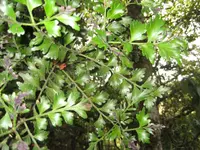
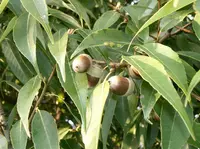
Possumhaw, Ilex decidua, is a deciduous holly shrub or small tree known for its bright red berries that persist through winter after the leaves drop. It has a naturally open, airy branching structure and typically forms a multi-stemmed shape.
This species is native to the southeastern and south-central United States, where it grows in bottomlands, woodland edges, and along streams. It is valued in landscapes for strong seasonal interest and wildlife support.
Possumhaw is generally considered easy to grow if planted in suitable conditions. It tolerates a range of soils, prefers consistent moisture, and grows best in full sun to light shade, which simplifies how to care for possumhaw.

Care Difficulty
Easy Care

Light Preference
Full Sun

Water Requirements
Moderate Water

Temperature Preference
Cold Hardy

Hardiness Zone
5–9

Soil Texture
Sandy, Loamy, Clay

Soil pH
Acidic (5.5–6.5), Slightly acidic (6.5–7.0)

Soil Drainage
Moist but well-drained

Fertilization
Minimal (feed rarely)
Scan your plant to receive care tips personalized for your specific plant
Available on iOS and Android
Ilex decidua thrives in full sun to light shade, which supports dense branching and heavy berry production.
Ilex decidua prefers evenly moist, well-drained soil once established, with short dry spells tolerated.
This deciduous holly is naturally cold-hardy and tolerates a wide range of outdoor temperatures in temperate regions.
Humidity is rarely a concern for Ilex decidua, which is adapted to outdoor conditions across a wide range.
Ilex decidua prefers consistently moist, well-drained mineral soil that does not stay waterlogged.
This species can be grown in large outdoor containers but needs careful attention to stability and moisture management.
Ilex decidua is a low-maintenance native shrub that benefits from light, thoughtful fertilization in poorer soils.
Ilex decidua responds well to selective pruning that maintains structure and berry production.
This species is usually grown in the ground, so transplanting young plants correctly is more important than frequent repotting.
Ilex decidua can be propagated by seeds or semi-hardwood cuttings with patience and controlled conditions.
This deciduous holly is cold hardy in much of the US and usually needs minimal winter care once established.

Plant Health Check
Not sure what's wrong with your plant? Check your plant's health inside the app.
This deciduous holly drops its leaves in late fall, leaving dense clusters of bright red berries highly visible on the bare branches, which provides important winter food for birds in the southeastern and south-central United States.
In the wild, this species commonly grows along stream banks, seasonally flooded bottomlands, and pond margins, showing strong tolerance to periodic flooding and heavy, poorly drained soils.
Individual plants are either male or female, so only female shrubs produce berries, and they require nearby male plants of compatible flowering time for successful pollination and fruit set.

Native populations of this species form part of the understory and edge vegetation in oak–hickory and pine–hardwood forests, where its dense branching and persistent fruit support wintering songbirds such as cedar waxwings and American robins, making it a valuable structural and food resource in degraded or fragmented habitats.
Growth is moderate. Young plants often add 20–30 cm of height per year under good conditions, then slow slightly with age. Adequate light, moisture, and space help maintain steady extension growth and healthy branching structure.
Keep your plants happy and healthy with plant identification, disease detection, and easy care guidance.