Mark Dormant Spots
Tag the clump with a durable label and lightly mark its outline in late fall so you avoid disturbing the hidden tubers when digging or planting nearby in winter and early spring.

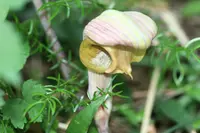
The cobra lily, Arisaema ringens, is a shade-loving woodland perennial grown mainly for its unusual, architectural flowers and bold foliage. It forms clumps from underground tubers and emerges in spring. The plant is native to Japan, Korea, and parts of China, where it grows in moist, humus-rich forest soils. Its hooded flower structure and mottled stems give it an exotic appearance in temperate gardens. This species is relatively easy for patient gardeners but can be slow to establish and resents drying out. It prefers dappled light, consistently moist but well-drained soil, and protection from harsh afternoon sun, which helps when planning how to care for cobra lily.

Care Difficulty
Moderate Care

Light Preference
Partial Shade

Water Requirements
Regular Water

Temperature Preference
Cold Hardy

Hardiness Zone
5–8

Soil Texture
Loamy, Peaty, Organic-rich

Soil pH
Acidic (5.5–6.5), Slightly acidic (6.5–7.0)

Soil Drainage
Moist but well-drained

Fertilization
Minimal (feed rarely)
Scan your plant to receive care tips personalized for your specific plant
Available on iOS and Android
This woodland perennial prefers bright shade that mimics a forest understory.
This species prefers evenly moist, cool soil without becoming waterlogged.
This plant is a cool-temperate woodland species with a distinct dormant period.
This species prefers moderate, stable humidity but usually adapts to typical indoor air if other conditions are correct.
Arisaema ringens grows best in consistently moist, humus-rich soil that never becomes waterlogged.
This species adapts well to container growing when moisture and drainage are carefully controlled.
Arisaema ringens benefits from modest feeding to support leaf and tuber growth but does not need heavy fertilization.
Arisaema ringens needs minimal pruning, mainly to keep the clump clean and healthy.
This woodland perennial resents disturbance, so transplant or repot Arisaema ringens only when clearly necessary.
New plants of cobra lily are most reliably produced by careful division of established clumps rather than seed.
This species is generally cold hardy in suitable climates but benefits from modest winter root-zone protection.

Plant Health Check
Not sure what's wrong with your plant? Check your plant's health inside the app.
The inflorescence has a glossy, helmet-like spathe that nearly encloses the central spadix, creating a chamber that temporarily traps visiting insects and increases the chances of successful pollination.
This species is protandrous, meaning young or smaller plants typically function as male and, as the corm grows larger and energy reserves increase, may switch to producing female flowers in later seasons.
Mature plants characteristically produce only two thick, leathery, highly glossy leaves that form a low, umbrella-like canopy above the soil, a distinctive feature that makes it easy to distinguish from many other Arisaema species.

In its native range in Japan and parts of eastern Asia, this species is often found in shaded, humus-rich forest floors where its unusual helmet-shaped flowers emerge very early in the growing season, sometimes appearing before the surrounding vegetation has fully leafed out, giving it a brief window of reduced competition for pollinators.
Lack of flowering often results from insufficient plant maturity, inadequate winter chill, or low light levels in spring. Crowded tubers and nutrient-poor soil also reduce bloom. Dividing clumps and improving soil fertility usually restores flowering.
Keep your plants happy and healthy with plant identification, disease detection, and easy care guidance.