Division for Renewal
Lift and divide crowded clumps every 3–4 years in late winter, replanting healthy fans with strong roots to maintain flowering performance and prevent the center of the clump from dying out.

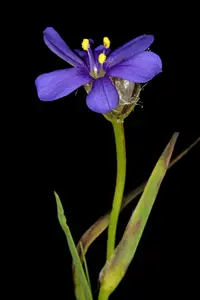
African capeblue (Aristea africana) is a small, clump-forming perennial from the iris family, valued for its vivid blue, star-shaped flowers. It produces narrow, sword-like leaves and short flowering stalks that give a neat, upright look, suitable for pots or small garden spaces.
This species comes from the winter-rainfall regions of South Africa, where it grows in open, sunny habitats with well-drained, often sandy soils. Flowering shows best in bright light and with moderate, consistent moisture that never leaves the roots waterlogged.
Gardeners who care for African Capeblue usually find it moderately easy if provided with sharp drainage and a cool to mild climate. It suits growers who can offer a dry rest period after flowering.

Care Difficulty
Moderate Care

Light Preference
Full Sun

Water Requirements
Moderate Water

Temperature Preference
Warm Climate

Hardiness Zone
9–11

Soil Texture
Sandy, Loamy, Organic-rich

Soil pH
Acidic (5.5–6.5), Slightly acidic (6.5–7.0)

Soil Drainage
Well-drained

Fertilization
Minimal (feed rarely)
Scan your plant to receive care tips personalized for your specific plant
Available on iOS and Android
This sun-loving South African perennial flowers best with strong light and mild summer heat.
This rhizomatous perennial prefers steady moisture in free-draining soil, especially during active growth.
This species prefers mild, frost-free conditions similar to Mediterranean or coastal climates.
This species accepts a range of household humidity but grows best with slightly raised moisture in the air.
Aristea africana prefers sharply drained, lean soil that mimics its native, rocky habitats.
This species is suitable for container growing when root space and drainage are managed carefully.
Aristea africana benefits from light, controlled feeding during its active growing season to support flowering without forcing soft, weak growth.
Aristea africana needs only light pruning to keep the clump tidy and to sustain flowering performance.
This clump-forming perennial is usually grown in the ground, but container plants and crowded clumps benefit from periodic transplanting.
Aristea africana is most often propagated by division, with seed used where patient, long-term establishment is acceptable.
This species prefers mild, frost-free to light-frost climates and needs protection in colder regions, especially in containers.

Plant Health Check
Not sure what's wrong with your plant? Check your plant's health inside the app.
This species is naturally restricted to the winter-rainfall region of South Africa’s Western Cape, where it grows in fynbos and rocky slopes with very well-drained, often nutrient-poor soils.
It behaves as a relatively short-lived perennial, often relying on self-seeding in suitable conditions to maintain populations rather than persisting as long-lived clumps.
Although it resembles many blue-flowering garden irises, it belongs to the genus Aristea, a distinct group within the iris family (Iridaceae) characterized by narrow, grass-like leaves and clusters of bright blue flowers on wiry stalks.
Poor flowering usually comes from insufficient light, depleted nutrients, or overcrowded clumps. Check that the plant receives bright conditions, divide congested rhizomes every few years, and apply a balanced, low-nitrogen fertilizer in early spring to support buds.
Keep your plants happy and healthy with plant identification, disease detection, and easy care guidance.