Brazilian Dutchman's Pipe Care (Aristolochia gigantea)

Brazilian Dutchman's Pipe

About Brazilian Dutchman's Pipe

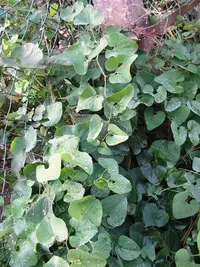
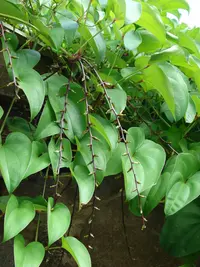
Brazilian dutchman's pipe (Aristolochia gigantea) is a fast-growing tropical vine valued for its large, unusual, pipe-shaped flowers and dense foliage. It is typically grown on trellises, arbors, or fences, where it can form a striking vertical screen.

This species is native to tropical regions of Brazil, where it grows in warm, humid environments with consistent moisture. It prefers bright light with some protection from harsh midday sun, plus well-drained, fertile soil.

The plant can be vigorous and somewhat demanding, so growers should understand how to care for Brazilian Dutchman's Pipe before planting it in smaller spaces. In suitable conditions, it rewards good support, regular watering, and protection from cold with abundant growth and dramatic blooms.

Main Plant Requirements

Care Difficulty

Moderate Care

Light Preference

Partial Sun

Water Requirements

Keep Soil Moist

Temperature Preference

Tropical / Frost Sensitive

Hardiness Zone

10–11

Soil Texture

Loamy, Sandy, Organic-rich

Soil pH

Acidic (5.5–6.5), Slightly acidic (6.5–7.0)

Soil Drainage

Moist but well-drained

Fertilization

Light (every 4–6 weeks)

Get Personalized Care Plan

Scan your plant to receive care tips personalized for your specific plant

Available on iOS and Android

How to Care for the Brazilian Dutchman's Pipe

This vigorous tropical vine needs bright, indirect light to flower well without leaf scorch.

  • Provide 4–6 hours of morning sun with light afternoon shade, or bright dappled shade all day in hotter regions for Brazilian Dutchman's Pipe.
  • Allow partial shade, but avoid deep shade; lanky, low-flowering growth indicates the plant is not receiving enough light.
  • Protect from harsh midday and late-afternoon sun, especially in summer, which can cause leaf burn and stress newly planted vines.

This plant prefers consistently moist, not soggy, soil that never dries out completely during active growth.

  • Irrigate when the top 2–4 cm of soil feels slightly dry, aiming for deep soaking rather than light splashes that only wet the surface.
  • Use rich, well-drained soil to prevent standing water; yellowing, soft leaves suggest overwatering, while wilting and crisp leaf edges point to underwatering.
  • Reduce watering in cooler seasons when growth slows, but do not allow Aristolochia gigantea roots to stay bone dry for extended periods.

This tropical vine grows best in warm, frost-free conditions throughout the year.

  • Aim for 68–85°F (20–29°C) for active growth, as cooler conditions slow flowering and shoot development.
  • Avoid temperatures below 45°F (7°C); foliage is damaged near this point, and hard frost can kill stems to the ground or the entire plant.
  • In hot climates above 90°F (32°C), provide afternoon shade and reliable soil moisture to limit heat stress and leaf scorch.

This vigorous vine prefers moderately humid air to support large leaf and flower growth.

  • Aim for 50–70% humidity; it tolerates brief dips lower but performs better near the higher end of this range.
  • Dry indoor air can lead to curled leaf edges, pale growth, and slowed vining on Brazilian Dutchman's Pipe.
  • Increase humidity with grouped plants, a nearby humidifier, or outdoor placement in a sheltered, naturally humid microclimate.

This climber needs consistently moist, well-aerated soil that drains freely but never dries out completely.

  • Use a loose, loamy mix built from roughly 50% compost or rich potting mix, 25% fine bark, and 25% perlite or coarse sand for structure and air spaces.
  • Keep pH slightly acidic to neutral, around 6.0–7.0, which supports nutrient uptake and healthy root growth in Aristolochia gigantea.
  • Ensure fast drainage so water runs through within seconds; standing water or heavy clay promotes root rot and stunted vines.
  • Improve aeration by avoiding soil compaction, filling containers gently, and refreshing the top layer with coarse materials if it begins to crust.

This species adapts well to container growing when given ample root space and strong support for climbing.

  • Select a deep, wide, and heavy container to stabilize the vigorous vine and prevent tipping as top growth increases.
  • Install a sturdy trellis or frame directly in the pot so stems can be tied and trained upward without pulling the container over.
  • Use a pot material with moderate moisture retention, such as thick plastic or glazed clay, to keep roots evenly moist in warm weather.

This vigorous tropical vine benefits from steady but moderate feeding to support foliage and flower production.

  • Use a balanced liquid fertilizer (around 10-10-10) at 1/2 strength every 2–4 weeks during the warm growing season.
  • Alternatively, apply a slow-release balanced fertilizer or a thin layer of mature compost in spring for long-term nutrition.
  • Reduce feeding in late fall and winter, stopping entirely if growth slows or temperatures drop below active-growing levels.
  • When caring for Brazilian Dutchman's Pipe in containers, flush the pot occasionally with plain water to avoid salt buildup.

Pruning helps manage size and encourage flowering on the vigorous climbing stems of Aristolochia gigantea.

  • Carry out main pruning in late winter or early spring before strong new growth begins.
  • Remove dead, damaged, or crossing stems first, then thin overly crowded growth to improve light and air flow.
  • Shorten long, wandering vines to maintain the desired framework and keep the plant within its support structure.
  • Use clean, sharp bypass pruners and make cuts just above a leaf node or side shoot to direct new growth.

This fast-growing vine benefits from timely transplanting or upsizing containers to support its extensive root system.

  • Look for roots circling the pot, pushing through drainage holes, or noticeably reduced shoot growth as signs it needs more space.
  • Plan to repot container-grown plants every 1–2 years in spring, shifting to a pot 1–2 in wider with sturdy support installed.
  • Lift carefully, keep the root ball largely intact, and only loosen tightly circling roots to limit transplant shock.
  • Water thoroughly after transplanting, keep in bright but not harsh sun for a week, and maintain even moisture while roots re-establish.

Propagation of this vine is possible from both seeds and semi-ripe cuttings when conditions are warm and stable.

  • Sow fresh seeds in late winter or spring in a warm (70–80°F), bright environment using a light, sterile seed-starting mix.
  • Take semi-ripe stem cuttings in late spring or summer, each with 2–3 nodes, removing lower leaves.
  • Dip the cut end in rooting hormone, then insert into moist, well-drained medium and keep humidity high with a cover or propagator.
  • Provide bottom heat if possible and bright, indirect light, keeping the medium just moist until firm new growth appears.

This tropical vine is frost-sensitive and needs protection in regions with cold winters.

  • In climates below USDA zone 10, grow in containers and move indoors or to a heated greenhouse before nights drop near 40°F.
  • For in-ground plants in marginal climates, mulch the root zone with 5–10 cm of organic material in late fall.
  • If stems are killed by light frost, cut back dead growth in late winter and allow new shoots to arise from protected buds.
  • Indoors, overwinter in bright light with temperatures above 60°F and slightly drier soil than in the main growing season.

Care Tips

Sturdy trellis support

Install a strong, non-flimsy trellis or wire system before planting, then guide new vines by loosely tying them with soft garden ties every 20–30 cm to prevent stems from kinking or breaking under their own weight.

Root zone mulching

Apply a 5–8 cm layer of organic mulch around the root zone, keeping it 5 cm away from the stem, to keep roots cool, reduce evaporation, and stabilize soil moisture during hot periods.

Flower weight management

In exposed or windy sites, add discreet ties or secondary supports beneath heavy flower-bearing stems so the large blooms do not bend or snap the vines.

Caterpillar management

Inspect foliage weekly in warm seasons and hand-pick caterpillars or use fine mesh barriers if needed, since Aristolochia species can attract butterfly larvae that rapidly defoliate new growth.

Container shift strategy

For container plants, rotate the pot a quarter turn every 2–3 weeks and slightly tilt or shift the container nearer to the light source as vines elongate, which helps balance growth and makes caring for Brazilian Dutchman's Pipe easier in limited spaces.

Common Pests and Diseases

Aristolochia swallowtail caterpillars

This pest is the larval stage of swallowtail butterflies that specialize on Aristolochia species and can rapidly skeletonize leaves. Symptoms include chewed margins, missing sections, and clusters of green or dark caterpillars on tender growth.

Solution

Handpick caterpillars and relocate them away from the vine, focusing on the youngest shoots where they feed most. For heavy infestations on ornamental specimens, protect key stems with fine insect netting and encourage natural predators like birds by avoiding broad-spectrum insecticides that would disrupt local ecology while growing Brazilian Dutchman's Pipe outdoors.

Spider mites

These insects are tiny sap-feeders that thrive in hot, dry conditions, causing stippled, dull foliage and fine webbing on the undersides of leaves. Symptoms include yellowing, leaf drop, and a dusty look to the vine when populations are high.

Solution

Rinse vines thoroughly with a firm stream of water, paying attention to leaf undersides, and repeat every few days to break the life cycle. In persistent cases, increase humidity, improve airflow, and apply insecticidal soap or horticultural oil, making sure to coat the undersides of leaves and avoid spraying in strong sun or high heat.

Leaf spot (fungal)

This disease causes small brown to dark purple spots that may enlarge, merge, and lead to premature leaf drop, especially in warm, humid weather. Symptoms include irregular lesions with yellow halos on older leaves and increased defoliation from the lower parts of the vine upward.

Solution

Remove and discard affected leaves and any fallen debris around the plant to reduce spores. Improve spacing and airflow, water at the base rather than overhead, and if spotting continues, use a labeled copper or chlorothalonil fungicide, applying according to instructions during extended wet periods.

Powdery mildew

This disease appears as white or gray powdery patches on leaves, stems, and buds, often starting on shaded or crowded parts of the vine. Symptoms include distorted new growth, dull leaves, and a gradual decline in vigor if left unmanaged.

Solution

Prune to open the plant to light and airflow, remove heavily affected leaves, and avoid late-day overhead watering. If needed, apply a sulfur or potassium bicarbonate fungicide labeled for ornamental vines, ensuring thorough coverage on both sides of leaves and repeating at recommended intervals during susceptible weather.

Interesting Facts

Carrion-mimicking flowers

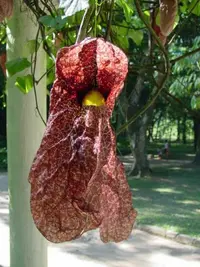
The huge maroon and white patterned flowers mimic rotting flesh in color and scent to attract carrion flies, which act as temporary pollinators rather than nectar feeders.

Trap-and-release pollination

The inner surface of the floral tube has downward-pointing hairs that guide and briefly trap flies near the reproductive structures; as the flower matures, the hairs soften so the insects can escape carrying pollen to the next bloom.

Warm-climate liana growth

In frost-free climates, this species behaves as a vigorous woody liana, producing long, twining stems that can rapidly cover supports when provided with consistent warmth and moisture.

Botan icon

Did you know?

Aristolochia gigantea is known to be toxic to swallowtail butterfly caterpillars native to North America, because its chemical profile differs from the North American Aristolochia species those butterflies evolved with, so planting it in butterfly gardens can inadvertently harm local larval populations.

FAQs about Brazilian Dutchman's Pipe

This species is a vigorous twining vine that climbs by wrapping its stems around supports. It does not form tendrils or cling like ivy, so it needs a trellis, arbor, fence, or sturdy wires to climb.

Grow Healthy Plants with Botan Care

Keep your plants happy and healthy with plant identification, disease detection, and easy care guidance.

Botan plant care app — identify plants on mobile

Explore More Plants