


Select sturdy support
Install a robust trellis, wire grid, or fence rated to hold substantial vine weight before planting, then loosely tie young shoots with soft ties so the vine learns the intended climbing route from the start.

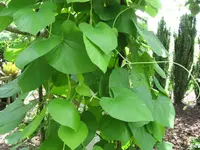
Woolly dutchman's pipe, Aristolochia tomentosa, is a deciduous woody vine known for its dense foliage and unusual, pipe-shaped flowers. The leaves are large, heart-shaped, and softly hairy, giving the plant its woolly appearance.
It naturally occurs in the central and eastern United States, often along woodland edges, riverbanks, and fences where it can climb freely. The vine grows vigorously and can cover structures, which makes it useful for shade or screening but requires regular control.
This species prefers moderate light, consistent moisture, and well-drained soil. Understanding how to care for woolly dutchman's pipe helps prevent it from becoming too rampant while keeping the plant healthy and attractive.

Care Difficulty
Moderate Care

Light Preference
Partial Sun

Water Requirements
Regular Water

Temperature Preference
Cold Hardy

Hardiness Zone
4–8

Soil Texture
Sandy, Loamy, Clay

Soil pH
Acidic (5.5–6.5), Slightly acidic (6.5–7.0)

Soil Drainage
Moist but well-drained

Fertilization
Minimal (feed rarely)
Scan your plant to receive care tips personalized for your specific plant
Available on iOS and Android
This deciduous vine prefers consistent, moderate light to support dense foliage and flowering.
This vine prefers evenly moist, not waterlogged, soil throughout the growing season.
This hardy vine tolerates a wide temperature range but grows best in moderate warmth.
This vine adapts well to typical household humidity but benefits from slightly moist air.
This species prefers deep, moisture-retentive yet aerated soil that does not stay waterlogged.
This vigorous vine can be grown in large containers if given stable support and sufficient root volume.
This hardy native vine needs only light feeding in typical garden soil, so caring for woolly dutchman's pipe focuses more on site choice than fertilizer.
Pruning supports manageable size and flowering display in Aristolochia tomentosa grown on arbors, fences, or trellises.
This vigorous vine is most often grown in the ground, so transplanting is more common than container repotting.
Propagation of Aristolochia tomentosa is moderately straightforward using seeds and softwood to semi-ripe cuttings.
This species is a cold-hardy, deciduous vine that usually needs minimal winter care in most temperate climates.

Plant Health Check
Not sure what's wrong with your plant? Check your plant's health inside the app.
The flowers trap small flies attracted by their scent and hairy inner surface, then release them once pollen has been transferred, a strategy that increases cross‑pollination efficiency.
This vine is a native larval host plant for the pipevine swallowtail butterfly in eastern North America, providing both food and chemical protection for the caterpillars.
Leaves and young stems are covered in soft, feltlike hairs that reduce water loss and can help protect tissues from intense sun exposure.

Some populations of Aristolochia tomentosa can climb 6–8 m into tree canopies, forming dense vertical curtains of foliage that create shaded microhabitats along woodland edges and stream banks.
This vine can spread vigorously by long stems and self-seeding, especially in mild, moist climates. Use strong supports, prune regularly, and remove unwanted seedlings to keep growth contained near intended structures or boundaries.
Keep your plants happy and healthy with plant identification, disease detection, and easy care guidance.

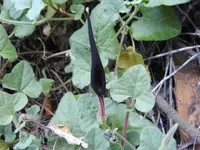
Wright's dutchman's pipe
Aristolochia wrightii
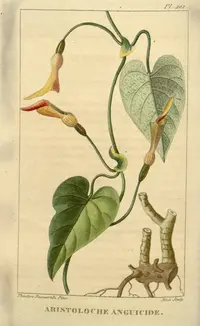
harlequin dutchman's pipe
Aristolochia anguicida
 POPULAR
Monstera lechleriana
Monstera lechleriana
 POPULAR
Philodendron Cobra
Monstera standleyana
Jelly Melon
Cucumis metuliferus
 POPULAR
Window-Leaf Monstera
Monstera obliqua
antidote caccoon
Fevillea cordifolia
 POPULAR
Monstera minima
Monstera minima