Improve crown drainage
Plant on a very slight mound or use a gravel mulch around the crown so water runs off the center, which helps prevent rot in wet winters when growing Armeria ruscinonensis.

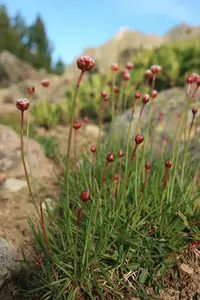
Armeria ruscinonensis is a compact, evergreen perennial in the thrift family, forming low cushions of narrow, grass-like leaves. It produces rounded clusters of small pink to purplish flowers on slender stems above the foliage, creating a neat mound of color. Native to rocky, coastal or dry habitats in parts of Europe, it is adapted to poor, well-drained soils and exposed conditions. This background makes it relatively easy to grow in rock gardens, gravel beds, and containers, provided drainage is good. It generally prefers full sun and moderate to low moisture, and it dislikes waterlogged or heavy soils. For gardeners looking to learn how to care for Armeria ruscinonensis, its needs are straightforward once drainage and light are correct.

Care Difficulty
Easy Care

Light Preference
Full Sun

Water Requirements
Low Water

Temperature Preference
Cold Hardy

Hardiness Zone
5–8

Soil Texture
Sandy, Loamy, Rocky

Soil pH
Acidic (5.5–6.5), Slightly acidic (6.5–7.0)

Soil Drainage
Well-drained

Fertilization
Minimal (feed rarely)
Scan your plant to receive care tips personalized for your specific plant
Available on iOS and Android
This compact coastal perennial thrives in bright, open positions with plenty of direct sun.
This species prefers slightly dry, very free-draining conditions and is sensitive to excess moisture.
This coastal-type perennial is quite hardy but grows best within a moderate temperature range.
This species handles a wide humidity range and usually does not need special humidity management.
This plant prefers lean, sharply drained soil that does not stay wet after rainfall or watering.
This species is well suited to container growing when drainage and root-zone aeration are prioritized.
This compact perennial stays healthiest with light, targeted feeding rather than rich soil or heavy fertilizer.
Thoughtful pruning keeps Armeria ruscinonensis compact, tidy, and free-flowering.
This species is usually grown in open ground or rock gardens and dislikes frequent disturbance.
Armeria ruscinonensis is commonly propagated by division, with seeds as a secondary option.
This species is generally cold hardy and needs only modest winter care in most temperate gardens.

Plant Health Check
Not sure what's wrong with your plant? Check your plant's health inside the app.
This species is native to coastal and near-coastal habitats of the eastern Pyrenees and adjacent Roussillon region in southern France and northeastern Spain, where it grows in dry, often rocky soils exposed to strong sun and wind.
In its natural range it is frequently associated with calcareous substrates, such as limestone outcrops and rocky grasslands, indicating adaptation to alkaline, mineral-rich but nutrient-poor soils.
The plant forms dense, low cushions of narrow leaves that help it resist desiccation and mechanical damage in exposed sites, while lifting its flower stalks above the foliage in late spring to improve pollinator access.
This species usually has a main flowering flush in late spring to early summer, then often repeats lighter bloom cycles if deadheaded. Removing spent flower stems and maintaining good light and drainage encourages extended, though not continuous, flowering periods.
Keep your plants happy and healthy with plant identification, disease detection, and easy care guidance.