Use fresh wood
Inoculate only freshly cut, disease-free hardwood logs or stumps, as older decomposed wood often hosts competing fungi that reduce colonization success when growing Armillaria limonea.

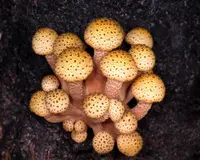
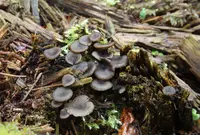
Armillaria limonea is a wood-decaying mushroom-forming fungus rather than a leafy houseplant. It typically produces clusters of honey-colored to yellow-brown caps on wood, often around tree bases or stumps. The caps sit on slender stems and are connected to extensive underground rhizomorphs, which are cord-like strands that spread through soil and wood.
This species occurs mainly in New Zealand forests and plantations, where it acts as both a decomposer and a potential tree pathogen. It is not a typical choice for home cultivation, and how to care for Armillaria limonea is mainly relevant to forestry or research settings, where moisture, host availability, and wood substrate strongly influence its growth and impact.

Care Difficulty
Moderate Care

Light Preference
Partial Shade

Water Requirements
Regular Water

Temperature Preference
Warm Climate

Hardiness Zone
Unknown

Soil Texture
Loamy

Soil pH
Slightly acidic (6.5–7.0)

Soil Drainage
Moist but well-drained

Fertilization
Minimal (feed rarely)
Scan your plant to receive care tips personalized for your specific plant
Available on iOS and Android
This fungus prefers low to moderate light, typical of shaded woodland or forest edges.
Moisture management focuses on keeping host wood or soil consistently damp but never waterlogged.
This species performs best in cool to mild conditions typical of temperate forests.
Humidity plays no meaningful role in this wood-rotting fungus, which develops in outdoor soil and woody substrates rather than as a typical humidity-sensitive houseplant.
This species colonizes woody roots and soil, so conditions that limit waterlogging but keep wood mildly moist are most relevant.
This species is not suitable for container growing, as it is a pathogenic root-rot fungus rather than an ornamental container plant.
This wood-decaying fungus is usually not fertilized, as it grows by decomposing host roots and woody material.
Pruning is not a standard management practice for this root-rot fungus and is usually limited to hygiene in affected areas.
Transplanting focuses on affected host plants rather than the fungus itself, which spreads underground via roots and rhizomorphs.
Propagation of this pathogenic fungus is not recommended as a horticultural practice and is generally discouraged.
Specific winter care is not applied to this fungus; management focuses on host trees and site hygiene across seasons.

Plant Health Check
Not sure what's wrong with your plant? Check your plant's health inside the app.
This species is native to New Zealand and is a major cause of Armillaria root rot in both natural forests and planted stands, especially affecting native trees such as Nothofagus and various podocarps.
It forms large subterranean systems of rhizomorphs, which are root-like fungal cords that spread through soil and wood, allowing the fungus to infect multiple trees across a site over many years.
The mycelium of this species is weakly bioluminescent, meaning the fungal tissues can emit a faint greenish light in the dark, a trait shared with several other Armillaria species.

Armillaria limonea was separated from other New Zealand Armillaria species based on detailed morphological features and mating tests, and its recognition as a distinct species has been important for accurately diagnosing and managing Armillaria root disease in commercial forestry plantations.
This fungus spreads aggressively through underground rhizomorphs, which are root-like fungal structures. It can move from stump to stump and between trees, often colonizing large areas of woody roots over time.
Keep your plants happy and healthy with plant identification, disease detection, and easy care guidance.