Spore-Friendly Site
Leave some spent fruiting bodies in place and avoid raking the area heavily so spores can release and colonize adjacent soil for more reliable future flushes.

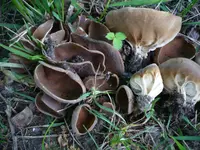
Helvella acetabulum, commonly called vinegar cup, is a cup-shaped spring fungus rather than a traditional leafy plant. It forms brown, goblet-like fruiting bodies with a strongly ribbed stem, often appearing in groups.
This species is native to temperate regions of Europe, North America, and parts of Asia, where it grows on soil in woodlands, park edges, and sometimes lawns. It relies on complex relationships with trees, so it does not adapt well to typical indoor or container culture.
Gardeners who try to care for Vinegar Cup usually find it unpredictable, since it depends on specific soil fungi and tree partners. It prefers undisturbed, well-drained soil with moderate moisture and light shade.

Care Difficulty
Hard Care

Light Preference
Partial Shade

Water Requirements
Regular Water

Temperature Preference
Cool Climate

Hardiness Zone
4–9

Soil Texture
Loamy, Silty, Organic-rich

Soil pH
Acidic (5.5–6.5), Slightly acidic (6.5–7.0)

Soil Drainage
Moist but well-drained

Fertilization
Minimal (feed rarely)
Scan your plant to receive care tips personalized for your specific plant
Available on iOS and Android
This cup fungus prefers woodland light similar to that found under deciduous trees in spring.
This fungus relies on consistently moist but not waterlogged soil conditions in its woodland habitat.
This species develops fruiting bodies best in mild, cool to moderately warm conditions.
This fungus fruits best in consistently moist, cool air, so humidity is a meaningful factor outdoors and in culture.
This cup fungus relies on moist, aerated, organic-rich soil rather than dense or compacted substrates.
This species is poorly suited to container growing and generally does not perform reliably in pots.
Helvella acetabulum is a wild, mycorrhizal fungus that generally should not be fertilized in cultivation.
Pruning is not a standard practice for Helvella acetabulum, as the fruiting bodies are short-lived and arise seasonally from the soil.
Transplanting this fungus is rarely successful, since Helvella acetabulum depends on a stable mycorrhizal partnership with host tree roots.
Propagation of this Vinegar Cup is complex and not recommended for typical home growers.
Helvella acetabulum is naturally cold hardy in temperate climates and generally needs no special winter care.

Plant Health Check
Not sure what's wrong with your plant? Check your plant's health inside the app.
This species forms a distinct, shallow cup with a smooth inner surface and a heavily ribbed and folded outer surface that runs down the stem, a combination that helps distinguish it from other cup fungi in the field.
It typically appears in early to mid-spring in temperate regions, often on soil rich in leaf litter in deciduous or mixed woodlands, sometimes forming scattered groups along paths and forest edges.
Evidence from field observations and ecological studies suggests this species may form mycorrhizal associations with trees, exchanging nutrients between its underground mycelium and host roots, although its nutrition strategy is not yet fully resolved.

Molecular research has led to several taxonomic revisions within the genus Helvella, and this species has served as a reference taxon in DNA-based studies that helped clarify relationships among saddle fungi and related cup-shaped ascomycetes.
This fungus is often reported as inedible or of doubtful edibility due to its rubbery texture and potential for confusion with toxic Helvella species. It is safest not to eat it and to treat it as non-culinary.
Keep your plants happy and healthy with plant identification, disease detection, and easy care guidance.