

horseradish Identification (Armoracia rusticana)

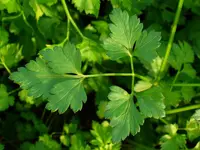
To recognize horseradish, look for a basal rosette of long, lance- to oblong-shaped leaves, often 12-24 inches (30-60 cm) long, with wavy or toothed edges and stout leaf stalks.

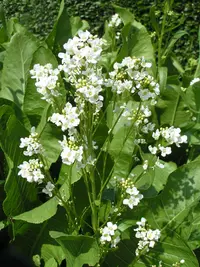
It grows as a clumping herbaceous perennial with upright flowering stems and small, four-petaled white flowers held in loose clusters above the foliage.

Armoracia rusticana Identification

Identify a Plant by Photo

Upload a plant photo and check the identification in seconds.

Clear images work best. Avoid photos taken too close or too far away

Use these visible traits to check for Armoracia rusticana.

  • Leaves form a basal clump, with long blades that are oblong to lance-shaped and often 12-24 inches (30-60 cm) long.
  • Leaf edges are strongly wavy or coarsely toothed, especially on the larger lower leaves.
  • Flowering stems rise above the leaves and carry many small white flowers in branched clusters.
  • Each flower has 4 petals in a cross shape, typical of the mustard family.

The overall look is a coarse clump of large leaves topped by airy white flower sprays.

Armoracia rusticana shows useful age-related shifts in leaf form, flowering stems, and overall habit.

  • Young plant: Begins as a basal rosette of smooth, bright green leaves. Early leaves are narrower and simpler, lacking the stronger waviness or lobing seen later.
  • Mature plant: Forms a larger clump with broad basal leaves, often 12-24 inches (30-60 cm) long. Margins become more wavy or irregularly lobed, and the crown looks denser.
  • Flowering stage: Sends up upright, branched stems above the leaf clump. Small white four-petaled flowers appear in loose clusters, making the plant look taller and more open than nonflowering plants.

In spring, horseradish sends up a fresh rosette of large, bright green basal leaves. These long, wavy-edged leaves are the main visible clue early in the season. Late spring to early summer may bring upright flower stalks with small white four-petaled flowers. After frost, the top growth dies back, and winter usually leaves little above ground beyond a dormant crown.

A few coarse mustard-family plants can be mistaken for horseradish.

broadleaf dock(Rumex obtusifolius)

Both form large basal leaves. Broadleaf dock leaves are broader, with a rounded or heart-shaped base, and the flower stalk carries many small greenish clusters. Horseradish has longer, more tapered leaves and white four-petaled flowers.

greater burdock(Arctium lappa)

Young plants also make big basal leaves. Burdock leaves are softly hairy beneath and soon send up branching stems with round burr-like flower heads. Horseradish leaves are smoother and its flowers are small, white, and held in loose clusters.

Armoracia rusticana is generally considered native to southeastern Europe and western Asia, though its exact original range is uncertain because it has long been cultivated and widely naturalized. In the wild or escaped from cultivation, it is most often found in moist places such as riverbanks, wet meadows, ditches, and field edges. That habitat can help narrow identification when a coarse mustard-family plant is growing in damp, disturbed ground rather than dry grassland or woodland.

  • Skin and eye irritation: Broken roots and leaves release pungent mustard oils. Skin contact can irritate humans, and splashes or vapors can strongly irritate the eyes.
  • Ingestion risk: The root is very acrid. Eating substantial amounts can irritate the mouth, throat, and stomach in humans and pets.
  • Hazardous look-alike: Its basal leaves can be confused with toxic dock, Veratrum viride, in the wild. Horseradish leaves smell sharp and mustard-like when crushed; false hellebore does not.

Confirm It from a Photo

Use Botan to identify or verify the plant from an image, helping avoid mix-ups with similar species.

FAQ

In dormancy, the leafy top dies back and little may remain above ground except a crown at soil level. The thick white taproot stays alive underground and resprouts basal leaves in spring.

More Plant Identification Guides

Find the Plant. Get the Details.

Identify a plant from a photo with Botan, then see its profile, care information, and common problems.

Botan app identifying a plant from a photo
Best Water for Plants – How to Choose the Right Type

7 min read · 13 Aug 2026

Best Water for Plants – How to Choose the Right Type

Rainwater, filtered, distilled, and tap water affect plants differently. Learn which types support healthy growth and which cause slow damage. Match each to your plants and discover how to easily improve tap water quality.

Plant Care
Best Water for Plants – How to Choose the Right Type
13 Best Front Yard Trees for Every Home and Yard

12 min read · 7 Aug 2026

13 Best Front Yard Trees for Every Home and Yard

A front yard tree can stay for decades. Therefore, choosing one deserves serious consideration. Here are 13 trees that have proven themselves, sorted by their purpose. You'll also find five species to avoid and basic planting information.

Plant Recommendations
13 Best Front Yard Trees for Every Home and Yard
12 Best Plants for Bathroom That Thrive in Humid Conditions

9 min read · 29 Sept 2026

12 Best Plants for Bathroom That Thrive in Humid Conditions

Discover the 12 best plants for bathroom spaces. Each pick comes with its own advantages, plus light, humidity, watering, and placement tips. Take a look and match the plant to your specific bathroom.

Plant Recommendations
12 Best Plants for Bathroom That Thrive in Humid Conditions