Rhizome-friendly mounting
Mount the plant on a slab of bark, tree fern fiber, or a loose sphagnum pad so the creeping rhizomes can attach and spread without being buried, which reduces rot and promotes healthier new fronds.

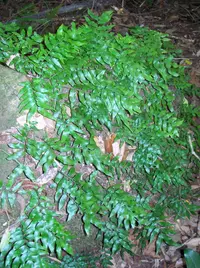
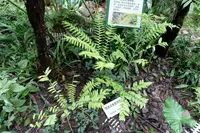
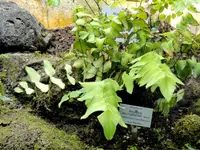
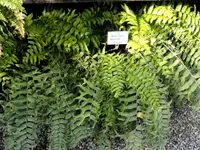
Climbing fern, Arthropteris tenella, is a small, delicate fern that naturally scrambles over rocks, tree trunks, and mossy ground in warm, humid forests. It forms trailing or creeping fronds, creating a fine-textured green cover rather than an upright clump.
This species is native to parts of Australia and nearby regions, where it benefits from shaded, consistently moist habitats. Its thin fronds and shallow roots make it somewhat sensitive to drying out and sudden environmental changes.
Because of this sensitivity, it is considered moderately challenging for beginners, but manageable if humidity and moisture are kept stable. Understanding how to care for Climbing Fern mainly involves providing soft light, even moisture, and a loose, well-drained substrate.

Care Difficulty
Moderate Care

Light Preference
Partial Shade

Water Requirements
Keep Soil Moist

Temperature Preference
Tropical / Frost Sensitive

Hardiness Zone
10–11

Soil Texture
Loamy, Organic-rich, Peaty

Soil pH
Acidic (5.5–6.5), Slightly acidic (6.5–7.0)

Soil Drainage
Moist but well-drained

Fertilization
Minimal (feed rarely)
Scan your plant to receive care tips personalized for your specific plant
Available on iOS and Android
Arthropteris tenella prefers soft, filtered light that mimics shaded forest conditions.
This fern needs consistently moist but not waterlogged soil to stay healthy.
This species prefers mild, frost-free conditions with moderate temperature swings.
This fern prefers consistently moist air and reacts quickly to dry indoor conditions.
This fern needs a loose, moist, organic-rich substrate that drains freely yet never dries out completely.
This species adapts well to container growing when moisture and stability are carefully managed.
This fern benefits from light, consistent nutrition rather than heavy feeding.
Pruning for Arthropteris tenella is mainly hygienic and shaping rather than structural.
This fern prefers stable conditions and only occasional repotting or transplanting.
Propagation of Arthropteris tenella is usually done by division rather than spores for home growers.
This fern is only mildly cold tolerant and benefits from some winter protection in cooler climates.

Plant Health Check
Not sure what's wrong with your plant? Check your plant's health inside the app.
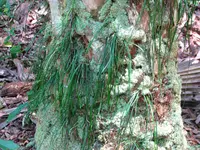
This species is a very small fern that often grows as an epiphyte on tree trunks or as a lithophyte on rocks, forming delicate, creeping mats rather than large fronds.
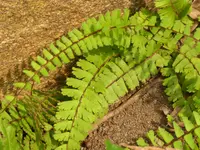
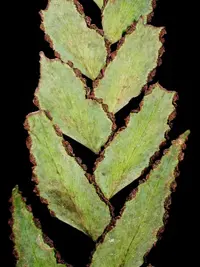
Its fronds are divided into tiny, rounded pinnae that resemble rows of beads along a thin midrib, an adaptation that reduces leaf area while still allowing efficient photosynthesis in shaded habitats.
This fern is naturally found in moist forests of eastern Australia, New Zealand, and some nearby islands, where it occupies humid microhabitats on bark, rock faces, and damp ground in deep shade.
This species forms slender creeping rhizomes that root along the surface and send out short, arching fronds. It behaves more as a scrambling or trailing fern than a true twining climber that wraps around supports.
Keep your plants happy and healthy with plant identification, disease detection, and easy care guidance.