Spring crown division
Divide mature clumps every 4–6 years in early spring, lifting and slicing the woody crown into large sections with several buds each to maintain vigor and prevent the center from dieback.

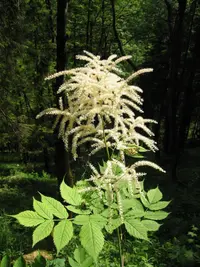
Bride's feathers (Aruncus dioicus) is a hardy, herbaceous perennial grown mainly for its tall, feathery flower plumes and dense, leafy clumps. It forms an upright, fountain-like shape that works well at the back of borders or along shaded woodland edges.
In the wild, it occurs in moist forests and stream banks across parts of North America, Europe, and Asia. Its preference for cool, consistently damp conditions and rich soil makes it straightforward to grow in suitable climates.
A mature plant can become quite large and long-lived, so choosing the right spot from the start makes it easier to care for bride's feathers over time.

Care Difficulty
Moderate Care

Light Preference
Partial Shade

Water Requirements
Keep Soil Moist

Temperature Preference
Cold Hardy

Hardiness Zone
3–7

Soil Texture
Loamy, Clay, Organic-rich

Soil pH
Acidic (5.5–6.5), Slightly acidic (6.5–7.0)

Soil Drainage
Moist but well-drained

Fertilization
Minimal (feed rarely)
Scan your plant to receive care tips personalized for your specific plant
Available on iOS and Android
This woodland perennial prefers cool, filtered light that mimics its native forest habitat.
This plant thrives in consistently moist, humus-rich soil, especially during its active growing season.
This hardy perennial is adapted to cool, temperate climates with distinct seasons.
This woodland perennial grows well in 40–70% humidity and usually does not need special humidity control outdoors.
This plant prefers consistently moist, deep, humus-rich soil with steady structure and drainage.
This species can be grown in containers, but large, deep pots are needed to support its tall, clump-forming growth.
Aruncus dioicus benefits from modest feeding on average garden soils but does not need heavy fertilization.
Pruning Aruncus dioicus is mainly about tidying and maintaining clump shape rather than strict size control.
This deep-rooted perennial is usually grown in-ground, so focus on careful transplanting rather than frequent repotting.
Aruncus dioicus is most practically propagated by division, with seed used mainly for larger-scale or patient growers.
This species is cold hardy in most temperate climates and usually needs minimal winter care in the ground.

Plant Health Check
Not sure what's wrong with your plant? Check your plant's health inside the app.
This species is dioecious, meaning individual plants produce only male or only female flowers, so both sexes are needed in a population to set viable seed.
In the wild, this plant typically grows along shaded stream banks and in cool, moist deciduous forests, where its deep root system stabilizes soil on slopes and riparian edges.
Although unrelated to true spiraeas, its large, featherlike flower plumes resemble them, and mature clumps in cool climates can reach human height, which is unusually tall for a member of the Rosaceae in woodland understories.

Aruncus dioicus is native both to parts of North America and Eurasia, making it a circumboreal species whose widely separated wild populations reflect an ancient, cold-adapted distribution pattern across the Northern Hemisphere.
This species forms large clumps over time through its rhizomes, but it is not usually invasive. It expands gradually, so allow enough space and divide crowded clumps every few years to keep it contained.
Keep your plants happy and healthy with plant identification, disease detection, and easy care guidance.