Little-brown-jugs Care (Asarum arifolium)

Little-brown-jugs

About Little-brown-jugs

Little-brown-jugs (Asarum arifolium) is a low, woodland perennial grown mainly for its distinctive heart-shaped, mottled foliage. It spreads slowly by rhizomes, forming a dense, ground-hugging carpet under shrubs and trees. Hidden at soil level, its jug-shaped brown flowers appear in spring and are often noticed only up close. This species is native to forested areas of the southeastern United States, where it thrives in shaded, humus-rich leaf litter. It generally prefers consistent moisture, shade to dappled light, and loose, well-drained soil. Once established, it is a steady, long-lived groundcover, and learning how to care for Little-brown-jugs mainly involves providing stable shade and organic-rich soil.

Main Plant Requirements

Care Difficulty

Moderate Care

Light Preference

Shade

Water Requirements

Keep Soil Moist

Temperature Preference

Cold Hardy

Hardiness Zone

6–9

Soil Texture

Loamy, Silty, Organic-rich

Soil pH

Acidic (5.5–6.5)

Soil Drainage

Moist but well-drained

Fertilization

Minimal (feed rarely)

Get Personalized Care Plan

Scan your plant to receive care tips personalized for your specific plant

Available on iOS and Android

How to Care for the Little-brown-jugs

This woodland perennial prefers low to moderate light that mimics dappled forest shade.

  • Provide bright shade to full shade, such as beneath trees or on the north or east side of buildings, avoiding direct midday and afternoon sun.
  • Allow 1–3 hours of early morning sun or filtered light; stronger sun bleaches foliage and can scorch Little-brown-jugs leaves, especially in dry conditions.
  • In hotter climates, choose deeper shade in summer; in cooler regions, light dappled shade supports denser growth without leaf burn.

This plant prefers consistently moist but not waterlogged soil.

  • Water when the top 2–3 cm of soil feels slightly dry, aiming for evenly damp soil around the shallow roots rather than soaking the area.
  • Use humus-rich, well-drained soil so excess water can drain away; poor drainage increases risk of root rot, wilting, and yellowing leaves from overwatering.
  • In spring and summer, monitor rainfall and supplement during dry spells; in fall and winter, reduce watering but do not allow the soil to stay bone dry for long.

This shade groundcover is hardy and tolerates a broad range of outdoor temperatures.

  • Best growth occurs around 60–75°F (16–24°C), when soil stays evenly moist and shaded; extreme swings slow new leaf production.
  • Asarum arifolium tolerates winter lows near 0°F (-18°C) once established, dying back partially in very cold spells but regrowing from rhizomes in spring.
  • In hot summers above 85°F (29°C), provide extra shade and mulch to keep roots cool; prolonged heat with dry soil can cause leaf scorch and decline.

This woodland perennial prefers consistently moist air similar to a shaded forest floor.

  • Aim for 50–70% humidity, especially in warm rooms or during heating season.
  • Tolerates brief dips to 40%, but prolonged dry air causes curled leaf edges and browning tips.
  • Increase humidity with grouped shade plants, a pebble tray under the pot, or a nearby room humidifier when caring for Little-brown-jugs.

This species performs best in loose, humus-rich soil that mimics a deciduous forest floor.

  • Use a mix of about 50% fine compost or leaf mold, 30% peat-free potting soil, and 20% fine bark to provide organic-rich, friable structure.
  • Ensure drainage is moderate: soil should stay evenly moist but never waterlogged, with excess water draining within a few minutes.
  • Maintain slightly acidic to neutral pH around 5.8–7.0, avoiding strongly alkaline substrates that can limit nutrient availability.
  • Improve aeration by blending in fine bark or a small amount of perlite, and avoid heavy clay or pure sand that compacts or dries too fast.

This species can be grown in containers when moisture and shade are managed carefully.

  • Choose a wide, shallow pot to accommodate its creeping rhizomes without forcing them into a deep, compact column of mix.
  • Use a heavier ceramic or clay container to steady the plant as the colony spreads horizontally near the rim.
  • Line the bottom above the drainage holes with a thin layer of coarse bark to prevent mix loss while keeping outflow unobstructed.

This woodland perennial grows well in humus-rich soil and needs only light feeding for healthy foliage and roots.

  • Apply a thin layer of compost or leaf mold around clumps in early spring to mimic natural forest litter for Little-brown-jugs.
  • If growth is weak, use a balanced, slow-release fertilizer (such as 10-10-10) at half strength once in spring.
  • Avoid summer high-salt synthetic feeds; excess nutrients can damage shallow rhizomes and reduce long-term vigor.
  • Do not fertilize during winter dormancy; allow the plant to rest and rely on existing soil reserves.

Asarum arifolium needs minimal pruning, mainly to keep the foliage tidy and disease-free.

  • Best time for cleanup is late winter to very early spring before new growth emerges.
  • Use clean hand pruners or scissors to remove dead, damaged, or diseased leaves at their base.
  • Thin out badly crowded, yellowing foliage to improve air movement and reduce fungal issues.
  • Avoid cutting into the underground rhizomes; pruning does not shape the plant but simply refreshes its appearance.

This species is most often grown in the ground, with transplanting done infrequently to expand or reposition clumps.

  • Transplant in early spring or early fall when temperatures are mild and soil moisture is steady.
  • Move plants only when growth slows, clumps become crowded, or roots circle a container and emerge from drainage holes.
  • Lift clumps with a broad trowel, keeping as much soil around the shallow rhizomes and fine roots as possible.
  • Replant at the same depth in rich, moist, well-drained soil, then water thoroughly and shade from strong sun for 1–2 weeks to reduce stress.

This plant is most often propagated by division, which preserves the characteristics of the parent clump.

  • Divide mature clumps in early spring or early fall when soil is cool and moist.
  • Gently lift the clump and separate rhizomes by hand or with a clean knife, ensuring each piece has several healthy roots and a growth bud.
  • Replant divisions immediately at the same depth in humus-rich, consistently moist soil with partial to full shade.
  • Seed propagation is possible but slow; sow fresh seed in cool, shaded outdoor pots and allow natural winter chilling for germination.

This woodland perennial is generally cold hardy in much of the US and needs only modest winter attention in the ground.

  • Mulch with 5–8 cm of shredded leaves or compost in late fall to insulate the shallow rhizomes and moderate soil temperature.
  • In very cold or exposed sites, increase mulch depth but keep it loose to avoid trapping excess moisture against the crown.
  • Container-grown plants benefit from moving to a sheltered, unheated but frost-free area or from heavy pot mulching to protect roots.

Care Tips

Leaf mulch blanket

Maintain a 3–5 cm layer of shredded leaf mulch over the rhizomes year-round to keep the soil cool, conserve moisture, and mimic the forest floor these plants naturally inhabit.

Slow clump expansion

Every 3–4 years, lift and divide congested rhizome clumps in early spring, replanting divisions shallowly to prevent center die-out and to create new patches for growing Little-brown-jugs in other shaded spots.

Slug and snail management

Use iron phosphate pellets or beer traps around the planting area in early spring to protect emerging foliage from slug and snail damage, which can permanently scar the leaves.

Gentle weed suppression

Hand-pull weeds rather than hoeing or cultivating near the plants so the shallow rhizomes and roots are not damaged, which can slow growth and increase stress.

Leaf litter integration

Allow some tree leaves to fall and decompose naturally among the plants each autumn, then lightly chop or crumble them in place to form a slow-release organic layer that supports healthy rhizome growth without synthetic additives.

Common Pests and Diseases

Slugs and snails

This pest is strongly attracted to the moist, shaded conditions that little brown jugs prefer and often chews large, irregular holes in leaves, sometimes stripping foliage to midribs.

Solution

Hand-pick at dusk or after rain, use iron phosphate bait around but not on the crowns, and place physical barriers like copper tape or rough diatomaceous earth near vulnerable clumps; reduce excess leaf litter directly around plants while still maintaining general shade and moisture that are important for Asarum arifolium care.

Fungal leaf spots

This disease appears as small brown or purplish spots that may merge into larger blotches, often developing in prolonged cool, damp shade with poor air movement.

Solution

Remove and discard affected leaves, avoid overhead watering, thin surrounding vegetation to slightly improve airflow, and if spots spread, apply a targeted ornamental foliage fungicide labeled for leaf spots, following the label closely.

Rust

This disease causes orange to brown powdery pustules on the undersides of leaves, sometimes with yellowing on the upper surface and premature leaf drop in very humid, shaded beds.

Solution

Promptly remove and dispose of infected leaves, avoid wetting foliage, increase spacing to allow better air circulation, and in persistent cases use a rust-specific fungicide suitable for shade perennials applied early in the season.

Vine weevils

This pest causes notched leaf edges from adult feeding, while larvae in the soil chew on roots and rhizomes, leading to wilting or stunted clumps, especially in container or raised plantings.

Solution

Inspect at night and manually remove adults, use biological control with beneficial nematodes targeted at vine weevil larvae in moist soil, and avoid keeping containers constantly saturated so roots can recover while still maintaining the even moisture that suits growing Little-brown-jugs.

Interesting Facts

Jug-shaped ground flowers

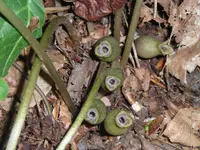
This species produces small, jug-shaped flowers at soil level, often partially buried in leaf litter, where they are more accessible to crawling insects rather than flying pollinators.

Arrowhead evergreen leaves

Its thick, arrowhead-shaped leaves are evergreen to semi-evergreen in mild climates, forming low, dense clumps that help shade and cool the forest soil.

Ant-assisted seed dispersal

The seeds carry a fatty appendage called an elaiosome, which attracts ants; ants carry the seeds to their nests, eat the elaiosome, and leave the intact seed to germinate, a process known as myrmecochory.

Botan icon

Did you know?

The flowers have a faint, earthy scent and dark, mottled coloring that together mimic decaying organic material, an adaptation thought to attract small detritus-feeding insects that act as pollinators on the forest floor.

FAQs about Little-brown-jugs

This woodland species is semi-evergreen in mild climates, often holding leaves through winter. In colder regions, foliage may die back and re-sprout from rhizomes in spring, so its evergreen appearance depends on local winter severity.

Grow Healthy Plants with Botan Care

Keep your plants happy and healthy with plant identification, disease detection, and easy care guidance.

Botan plant care app — identify plants on mobile

Explore More Plants