Leaf litter mulch
Leave a thin layer of shredded leaves around the crowns each autumn to mimic its woodland habitat, keeping roots cool, conserving moisture, and slowly adding organic matter without smothering new growth.

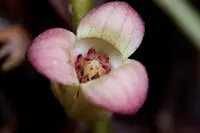
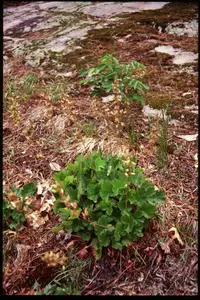
Lemmon's wildginger (Asarum lemmonii) is a low, rhizomatous woodland perennial native to coniferous forests of northern California and southwestern Oregon. It forms dense ground-hugging clumps of heart-shaped, often mottled leaves that create a natural, woodland look.
The flowers are small, jug-shaped, and usually hidden beneath the foliage, valued more by plant enthusiasts than by casual viewers. It spreads slowly over time, making a stable groundcover under trees.
This species favors cool, shaded sites with consistently moist, humus-rich soil. These traits make it rewarding but slightly demanding, so understanding how to care for Lemmon's wildginger is important for long-term success.

Care Difficulty
Moderate Care

Light Preference
Shade

Water Requirements
Keep Soil Moist

Temperature Preference
Cold Hardy

Hardiness Zone
6–9

Soil Texture
Loamy, Silty, Organic-rich

Soil pH
Acidic (5.5–6.5), Slightly acidic (6.5–7.0)

Soil Drainage
Moist but well-drained

Fertilization
Minimal (feed rarely)
Scan your plant to receive care tips personalized for your specific plant
Available on iOS and Android
This woodland perennial prefers cool, shaded conditions that mimic a forest floor.
This plant needs consistently moist but not saturated soil throughout the growing season.
This species is adapted to cool, temperate woodland climates with mild summers.
This woodland perennial prefers moderately moist air but usually adapts to typical home humidity.
Asarum lemmonii thrives in loose, humus-rich soil that mimics a shaded forest floor.
This species can grow well in containers when moisture and shade are managed carefully.
This woodland perennial needs minimal feeding, as Lemmon's wildginger is adapted to low-nutrient forest soils.
Asarum lemmonii requires only light, maintenance-focused pruning to keep the clump clean and healthy.
This species is more often transplanted in the ground than repotted in containers, as it forms slow, creeping clumps.
Propagation of Asarum lemmonii is usually done by division, with seed used mainly by specialists or for restoration work.
This woodland groundcover is generally cold hardy in its native range and needs little active winter care in the ground.

Plant Health Check
Not sure what's wrong with your plant? Check your plant's health inside the app.
This species is native to a very restricted area of the Klamath-Siskiyou region of northern California and southwestern Oregon, where it typically grows in mixed conifer forests on moist, shaded slopes and streambanks.
Its purple-brown, jug-shaped flowers form at ground level beneath the leaf litter, where they are partly concealed by the two mottled leaves that help camouflage them on the forest floor.
Like several other wild gingers, it produces seeds with small, fleshy appendages called elaiosomes that attract ants, which carry the seeds away and help disperse the plant across the forest understory.

Genetic and morphological studies place this species within a small group of western North American wild gingers that likely diverged as the Klamath-Siskiyou region became a long-term glacial refuge, making it a relict plant tied closely to the area’s ancient, stable microclimates.
This species spreads slowly by short rhizomes, forming small clumps or loose colonies over time. It is not considered aggressive or invasive and is usually easy to contain with normal edging and occasional division.
Keep your plants happy and healthy with plant identification, disease detection, and easy care guidance.