Encourage Deep Roots
During the first warm season, water less often but more deeply to encourage a long taproot, which helps the plant handle heat, wind, and drought more effectively in later years.

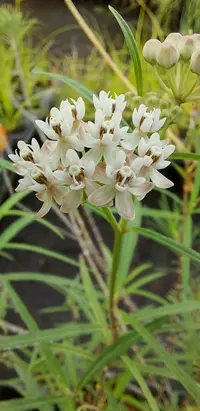
Arizona milkweed, Asclepias angustifolia, is a perennial wildflower native to arid regions of the southwestern United States and northern Mexico. It naturally occurs in open deserts, grasslands, and rocky slopes.
The plant forms upright, slender stems with narrow, linear leaves and clusters of pale cream to pinkish flowers that attract butterflies, especially monarchs. Its deep root system and drought tolerance make it well adapted to hot, dry climates.
Asclepias angustifolia prefers full sun, fast-draining soil, and low to moderate water once established. These traits make it relatively easy to care for Arizona milkweed in suitable dry, sunny landscapes.

Care Difficulty
Moderate Care

Light Preference
Full Sun

Water Requirements
Low Water

Temperature Preference
Warm Climate

Hardiness Zone
8–11

Soil Texture
Sandy, Loamy, Rocky

Soil pH
Slightly acidic (6.5–7.0), Neutral (7.0)

Soil Drainage
Well-drained

Fertilization
Minimal (feed rarely)
Scan your plant to receive care tips personalized for your specific plant
Available on iOS and Android
This drought-adapted milkweed needs strong sun to flower and stay compact.
Asclepias angustifolia prefers deep, infrequent watering once established.
This species is adapted to hot, dry climates but still benefits from a defined temperature range.
This drought-adapted species handles low humidity well and rarely needs special humidity management.
Asclepias angustifolia prefers mineral, sharply drained soil that mimics dry desert or grassland conditions.
This species can grow in containers if the pot and medium are chosen to keep roots dry and stable.
This desert native needs minimal feeding, but light nutrition can support healthy growth when grown in containers or poor soils.
Pruning Asclepias angustifolia is simple and mainly focuses on keeping plants healthy and tidy.
This milkweed prefers to stay put, so transplanting should be infrequent and done with care.
Propagation of Asclepias angustifolia is most reliable from seed, with a few key steps improving success.
This species is fairly cold hardy in much of its range and usually needs only minimal winter attention.

Plant Health Check
Not sure what's wrong with your plant? Check your plant's health inside the app.
This species is naturally restricted to moist edges of streams and seeps in the Sonoran Desert, especially in Arizona, rather than the open prairies where many other milkweeds grow.
Its very narrow, grasslike leaves reduce surface area and help limit water loss, an adaptation to the hot, arid habitats where it occurs.
In parts of central and southern Arizona, this milkweed serves as an important larval host for monarch and queen butterflies when few other native milkweed species are present.

Arizona populations of this species are considered of conservation interest because it has a relatively limited distribution tied to desert riparian corridors, making it vulnerable when groundwater levels drop or streamside habitats are altered.
This species is highly attractive to pollinators, especially native bees and monarch butterflies, which use it as a nectar source and, for monarchs, as a larval host plant for caterpillars.
Keep your plants happy and healthy with plant identification, disease detection, and easy care guidance.