Use low trays
Grow this plant in a wide, shallow pot or tray so the rhizomes and roots can spread laterally, which reduces waterlogging risk and keeps the clump dense and stable.

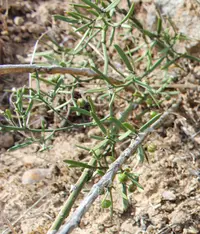
Asparagus striatus, commonly called hardleaf asparagus, is a shrubby, perennial species in the Asparagus genus. It has stiff, wiry stems and tough, narrow, needle-like foliage that gives it a spiky, architectural look.
This plant is native to arid and semi-arid regions of southern Africa, where it often grows among rocks and scrub. Its natural habitat makes it relatively drought-tolerant and suited to bright, dry conditions.
For those who want to care for Hardleaf Asparagus, it is generally considered a resilient plant if given good light, free-draining soil, and protection from prolonged frost.

Care Difficulty
Moderate Care

Light Preference
Partial Shade

Water Requirements
Moderate Water

Temperature Preference
Warm Climate

Hardiness Zone
9–11

Soil Texture
Sandy, Loamy, Organic-rich

Soil pH
Acidic (5.5–6.5), Slightly acidic (6.5–7.0)

Soil Drainage
Well-drained

Fertilization
Minimal (feed rarely)
Scan your plant to receive care tips personalized for your specific plant
Available on iOS and Android
Asparagus striatus prefers bright conditions with protection from intense midday sun.
Asparagus striatus prefers evenly moist, well-drained soil that never stays waterlogged.
This species grows best in mild, frost-free conditions with moderate seasonal variation.
This species tolerates typical indoor humidity but performs best with slightly moist air.
Asparagus striatus prefers a loose, sharply drained mix that still retains moderate moisture.
This species grows reliably in containers when given enough root space and fast drainage.
This drought-adapted species needs modest feeding, but light nutrients support steady growth in Hardleaf Asparagus containers or garden plantings.
Asparagus striatus responds well to light, targeted pruning that maintains its compact, arching form.
This species forms a tough root system that prefers infrequent disturbance, so repot or transplant only when clearly needed.
Asparagus striatus is usually propagated by seed or division, depending on whether the plant is in-ground or container-grown.
This species is moderately cold tolerant and often needs only minimal winter attention in mild climates.

Plant Health Check
Not sure what's wrong with your plant? Check your plant's health inside the app.
This species has strongly ridged, spine-tipped cladodes (leaf-like stems) instead of true leaves, an adaptation that reduces water loss in its dry South African habitats.
It is naturally restricted to arid and semi-arid regions of South Africa’s Karoo and adjacent areas, where it often grows among rocky slopes and open shrubland rather than in forests.
The plant forms fleshy, tuberous roots that store water and carbohydrates, allowing it to survive long dry periods and resprout after stress such as drought or light disturbance.

Asparagus striatus was previously placed in a broadly defined Asparagus group but is now recognized as part of a diverse southern African radiation of shrubby, spiny asparagus species that evolved multiple times from ancestors with softer, ferny foliage.
Brown leaf tips or segments usually come from underwatering, low humidity, or excess fertilizer salts. Check soil moisture, flush the pot occasionally with plain water, and trim damaged parts. Sudden temperature swings or hot drafts can also scorch foliage.
Keep your plants happy and healthy with plant identification, disease detection, and easy care guidance.