


Rock-Crevice Planting
Mimic its natural habitat by tucking the root ball into a narrow rock crevice or between broken bricks or stones, which stabilizes the plant and keeps the rhizomes cool and evenly moist.

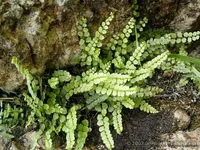
Ladder spleenwort, Asplenium adulterinum, is a small evergreen fern that grows in tight clusters with narrow, divided fronds forming a delicate ladder-like pattern. It stays compact and is usually found tucked into rock crevices or old walls.
In nature it occurs mainly in parts of central and southern Europe, often on metal-rich or rocky substrates where few other plants compete. Its slow growth, preference for stable moisture, and dislike of disturbance can make it a bit challenging for beginners.
Those learning how to care for ladder spleenwort should know it generally prefers cool, shaded conditions, evenly moist but not waterlogged soil, and good air circulation around the fronds.

Care Difficulty
Hard Care

Light Preference
Partial Shade

Water Requirements
Keep Soil Moist

Temperature Preference
Cool Climate

Hardiness Zone
6–8

Soil Texture
Loamy, Rocky, Organic-rich

Soil pH
Strongly acidic (4.5–5.5), Acidic (5.5–6.5)

Soil Drainage
Moist but well-drained

Fertilization
Minimal (feed rarely)
Scan your plant to receive care tips personalized for your specific plant
Available on iOS and Android
This small fern prefers cool, shaded sites that mimic moist rock crevices in nature.
Asplenium adulterinum requires consistently moist but not waterlogged conditions.
This fern prefers cool to mild temperatures and does not tolerate extreme heat or hard frost well.
This fern prefers consistently moist air to maintain healthy fronds.
This species needs a moist, sharply drained, humus-rich substrate similar to crevices in calcareous rocks.
This fern can adapt well to container culture when moisture and root space are managed carefully.
This small, rock-dwelling fern needs only light feeding; caring for ladder spleenwort focuses more on moisture and substrate than fertilizer.
Asplenium adulterinum needs minimal pruning, mainly to keep the clump clean and healthy.
This fern is usually grown in rock crevices or walls, so transplanting is infrequent and should be done gently.
Propagation of Asplenium adulterinum is possible but somewhat specialist, usually done by spore rather than division.
This fern is relatively cold hardy in suitable climates and usually needs only light winter attention outdoors.

Plant Health Check
Not sure what's wrong with your plant? Check your plant's health inside the app.
This species is widely regarded as a stabilised hybrid between Asplenium trichomanes and Asplenium viride, showing morphological traits intermediate between its parents.
It naturally occurs on nickel-rich serpentine and other ultramafic rocks, where many other plants struggle to survive, making it a specialist of metal-rich substrates.
Its native distribution is restricted to scattered localities in central and parts of southern Europe, often forming small, isolated populations in suitable rocky habitats.
This fern never produces true flowers. Instead, it forms spores on the undersides of its fronds for reproduction. Lack of blooms is normal and does not indicate any care problem or nutrient deficiency.
Keep your plants happy and healthy with plant identification, disease detection, and easy care guidance.

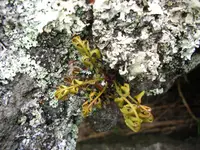
Egyptian spleenwort
Asplenium aethiopicum
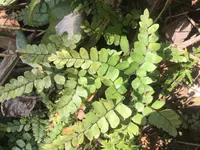
Fan-leaved Maidenhair
Adiantum flabellulatum
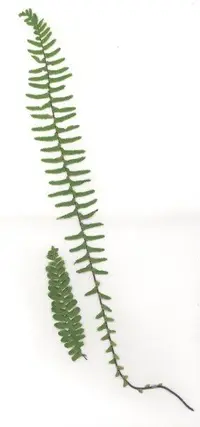
ebony spleenwort
Asplenium platyneuron
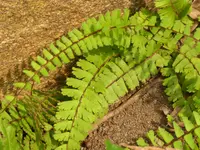
Torn Maidenhair Fern
Adiantum incisum
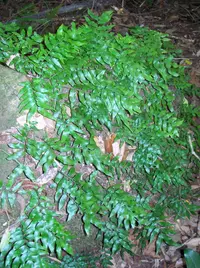
Climbing Fern
Arthropteris tenella
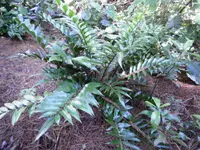
Shining Spleenwort
Asplenium oblongifolium
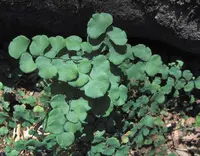
California maidenhair
Adiantum jordanii
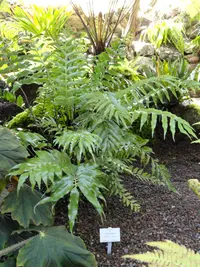
Lyall's Spleenwort
Asplenium lyallii