


Rock crevice planting
Plant in narrow rock crevices or between stacked stones with very shallow gritty mix to mimic its natural habitat and keep the roots cool and firmly anchored.

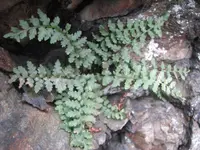
Bradley's spleenwort (Asplenium bradleyi) is a small, evergreen fern native to rocky cliffs and limestone outcrops in the eastern United States. It naturally grows in narrow crevices where soil and moisture are limited.
The plant forms compact clumps of dark green, divided fronds on short, wiry stems, giving it a neat, tufted appearance. Its slow growth and preference for stable, cool conditions make it more suited to patient growers.
This fern prefers bright, indirect light, steady moisture without waterlogging, and very well-drained, gritty, slightly alkaline substrates. Understanding these natural rock-habitat conditions is the key to how to care for Bradley's spleenwort.

Care Difficulty
Hard Care

Light Preference
Partial Shade

Water Requirements
Moderate Water

Temperature Preference
Cool Climate

Hardiness Zone
4–7

Soil Texture
Sandy, Rocky, Loamy

Soil pH
Acidic (5.5–6.5), Slightly acidic (6.5–7.0)

Soil Drainage
Well-drained

Fertilization
Minimal (feed rarely)
Scan your plant to receive care tips personalized for your specific plant
Available on iOS and Android
This small cliff-dwelling fern needs bright but sheltered light that mimics its native rocky ledges.
This fern prefers consistently moist but not saturated conditions around its roots and rhizomes.
This species is relatively cold-hardy but grows best in cool to mild conditions.
This fern prefers moderate, steady humidity rather than very dry air.
Asplenium bradleyi prefers a sharply draining yet humus-rich mix that mimics rocky, organic crevices.
This species can adapt to container culture when the pot is set up to prevent waterlogging and root stress.
This small, rock-dwelling fern needs only light feeding when grown in containers, as many native species grow well in lean conditions.
Asplenium bradleyi needs only light, hygienic pruning to keep the fern tidy and healthy.
This fern is usually grown on rocks or in shallow containers and prefers minimal disturbance.
This species is not commonly propagated at home, as it is a specialized rock fern with slow, delicate growth.
Asplenium bradleyi is fairly cold hardy in its native rocky habitats but container plants benefit from simple winter care.

Plant Health Check
Not sure what's wrong with your plant? Check your plant's health inside the app.
This fern is naturally restricted to steep, dry sandstone and shale cliffs in the Appalachian and Ozark regions, where it anchors its roots into tiny rock crevices instead of typical soil.
Botanists consider it to be of ancient hybrid origin between Asplenium montanum and Asplenium platyneuron, with chromosomes that have stabilized over evolutionary time so it now behaves as a distinct species.
Unlike most ferns, it tolerates relatively dry, exposed conditions and survives in thin rock substrates that heat up and lose moisture quickly during summer.

This species often forms part of a well-known complex of natural fern hybrids called the Asplenium hybrid complex, and in the wild it can occasionally hybridize again with related Asplenium species, creating additional rare, localized hybrid forms.
This species is slow-growing. In cultivation it usually adds only a few new fronds each year and may take several years to form a small clump. Patience is essential when trying to grow Asplenium bradleyi successfully.
Keep your plants happy and healthy with plant identification, disease detection, and easy care guidance.

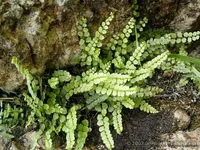
ladder spleenwort
Asplenium adulterinum
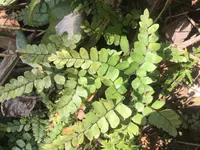
Fan-leaved Maidenhair
Adiantum flabellulatum
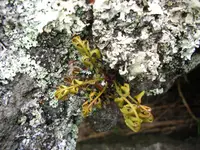
Egyptian spleenwort
Asplenium aethiopicum
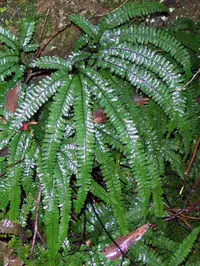
rough maidenhair
Adiantum hispidulum
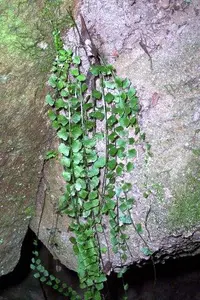
Necklace Fern
Asplenium flabellifolium
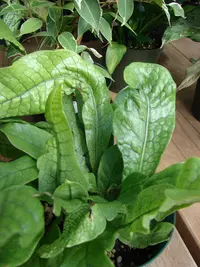
Microsorum musifolium
Microsorum musifolium
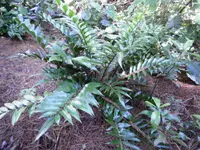
Shining Spleenwort
Asplenium oblongifolium
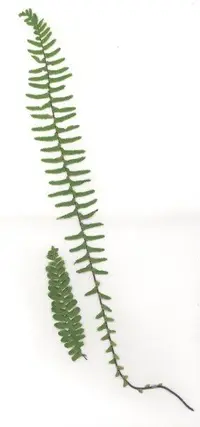
ebony spleenwort
Asplenium platyneuron