


Rocky planting pockets
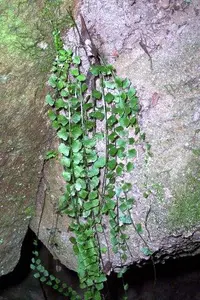
Tuck the roots into narrow crevices between rocks or broken pieces of stone to mimic coastal cliffs, which stabilizes the plant and keeps the crown slightly raised above the wettest substrate.

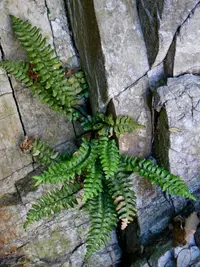
Sea spleenwort, Asplenium marinum, is a small evergreen fern that naturally grows on shaded sea cliffs, rocky crevices, and damp coastal walls. It forms compact clumps of arching, leathery fronds that stay green year-round.
This fern is adapted to salty air, wind, and periodic dryness around its roots, which makes it somewhat demanding away from its native habitat. Successful how to care for sea spleenwort usually depends on providing cool, humid air, good drainage, and protection from strong sun.
In cultivation it suits rock gardens, shaded stone walls, or containers in sheltered outdoor spots, and can be grown indoors if humidity and airflow are managed carefully.

Care Difficulty
Hard Care

Light Preference
Partial Shade

Water Requirements
Keep Soil Moist

Temperature Preference
Cool Climate

Hardiness Zone
7–10

Soil Texture
Sandy, Rocky, Organic-rich

Soil pH
Acidic (5.5–6.5)

Soil Drainage
Moist but well-drained

Fertilization
Minimal (feed rarely)
Scan your plant to receive care tips personalized for your specific plant
Available on iOS and Android
This coastal fern prefers soft, indirect light that mimics shaded sea cliffs.
This fern prefers steady moisture without prolonged saturation.
This species thrives in mild, maritime-type temperatures without sharp extremes.
This coastal fern prefers consistently moist air and reacts quickly to dry indoor conditions.
This species thrives in sharply drained yet moisture-retentive, organic-rich media that mimics rocky coastal crevices.
This fern adapts well to container culture when the pot supports its shallow, spreading root system.
In containers, sea spleenwort benefits from light, controlled feeding during active growth.
Asplenium marinum needs only light, hygienic pruning to keep the fern healthy and tidy.
This fern prefers stable conditions, so repot or transplant Asplenium marinum only when clearly needed.
Asplenium marinum is usually propagated by careful division rather than spores in home settings.
Outdoor Asplenium marinum tolerates only mild coastal winters and needs protection in colder climates.

Plant Health Check
Not sure what's wrong with your plant? Check your plant's health inside the app.
This fern is one of the few vascular plants that naturally lives on wave‑sprayed sea cliffs, anchoring in narrow crevices just above the high tide line along Atlantic and western European coasts.
Unlike most ferns, it tolerates regular exposure to salt spray and strong winds, thanks to its thick, leathery fronds that reduce water loss and damage from saline droplets.
In mild, oceanic regions it keeps its dark green fronds year‑round, taking advantage of the relatively stable coastal temperatures to photosynthesize even in winter.

Historical records from coastal Europe show that sea spleenwort was once collected by early botanists specifically as a curiosity, because so few ferns were known to thrive so close to breaking ocean waves on bare rock.
This species is a true fern and does not produce flowers or blooms. Instead, it forms spores on the undersides of its fronds for reproduction, so the absence of flowers is completely normal.
Keep your plants happy and healthy with plant identification, disease detection, and easy care guidance.

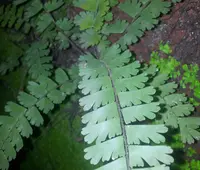
tailed maidenhair
Adiantum caudatum
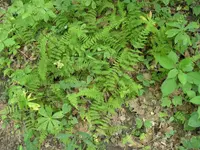
bulblet bladderfern
Cystopteris bulbifera
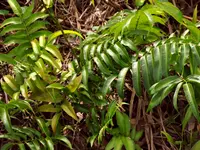
swamp vine fern
Stenochlaena palustris
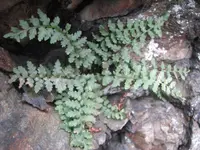
Bradley's spleenwort
Asplenium bradleyi
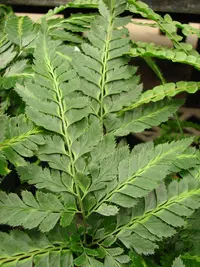
simpler hollyfern
Arachniodes simplicior
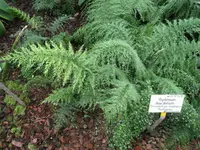
Mauritius spleenwort
Asplenium daucifolium
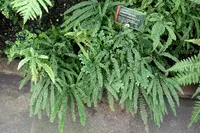
Filmy Maidenhair
Adiantum diaphanum
Necklace Fern
Asplenium flabellifolium