Provide climbing support
Install a sturdy trellis, wire mesh, or moss pole and gently tie young fronds and creeping stems to it so the plant can climb and produce longer, healthier fronds instead of sprawling weakly on the ground.

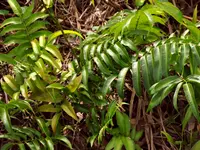
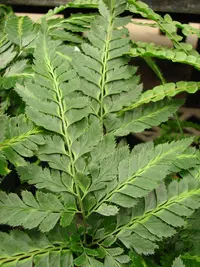
Swamp vine fern, Stenochlaena palustris, is a tropical climbing fern that forms long, twining stems with leathery, lance-shaped fronds. Young fronds often emerge reddish before turning glossy green.
In nature it grows in wetlands, mangroves, and swampy forests across Southeast Asia and parts of the tropics. It can be vigorous in warm, humid conditions, so space and support are important.
This species prefers consistently moist conditions, high humidity, and filtered light, which can make indoor culture slightly challenging in dry homes. Understanding how to care for swamp vine fern starts with replicating its naturally warm, damp habitat as closely as possible.

Care Difficulty
Moderate Care

Light Preference
Partial Shade

Water Requirements
Aquatic

Temperature Preference
Tropical / Frost Sensitive

Hardiness Zone
11–12

Soil Texture
Loamy, Silty, Organic-rich

Soil pH
Acidic (5.5–6.5), Slightly acidic (6.5–7.0)

Soil Drainage
Waterlogged tolerant

Fertilization
Minimal (feed rarely)
Scan your plant to receive care tips personalized for your specific plant
Available on iOS and Android
This tropical fern prefers bright, filtered light that mimics dappled forest or swamp-edge conditions.
This species favors consistently moist conditions but still benefits from some drainage to protect its roots.
This fern thrives in warm, humid climates and reacts poorly to cold or sudden temperature swings.
This species prefers consistently high humidity for best frond and vine development.
This fern favors constantly moist, airy, organic-rich soil resembling a loose wetland edge.
This species adapts well to container growing when moisture and support are managed carefully.
This fern benefits from light, consistent feeding during active growth but is sensitive to overfertilizing.
Pruning Stenochlaena palustris is mainly done to manage length and keep fronds healthy.
This fern tolerates being slightly rootbound but benefits from occasional repotting or careful transplanting.
Stenochlaena palustris is commonly propagated by division or stem cuttings under warm, humid conditions.
This tropical fern has low frost tolerance and needs protection in regions with cool or cold winters.

Plant Health Check
Not sure what's wrong with your plant? Check your plant's health inside the app.
The young, tightly coiled fronds of this fern are collected and eaten as a leafy vegetable in parts of Southeast Asia, especially in Malaysia and Indonesia, where they are commonly sold in local markets.
Unlike many ground-dwelling ferns, it can grow as a high-climbing vine, scrambling over trees and shrubs in swamp forests and mangroves, sometimes forming long, woody, liana-like stems.
This fern often occurs alongside mangrove trees in brackish, periodically flooded habitats, tolerating waterlogged soils that would quickly damage many other terrestrial ferns and making it an important structural component of some coastal wetland plant communities.

In parts of Southeast Asia, this species has been used as a natural dye plant, with its tissues providing pigments traditionally used to color materials such as rattan and textiles.
This species is a scrambling climber with long, twining fronds. In suitable conditions, it anchors to supports or nearby vegetation and can form dense, spreading mats if not pruned or physically directed.
Keep your plants happy and healthy with plant identification, disease detection, and easy care guidance.