

Protect shallow roots
Use a thin top-dressing of fine bark or leaf mold around the crown to keep the very shallow rhizomes cool, moist, and protected from disturbance in rocky crevices or shallow pots.

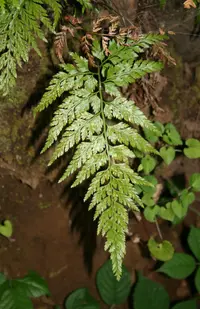
Western black spleenwort, Asplenium onopteris, is a small evergreen fern native to rocky and coastal regions of western and southern Europe and North Africa. It typically grows in tight clumps, with narrow, dark green fronds that form an upright, fountain-like shape.
This fern is adapted to shaded crevices and thin, well-drained soils, often on limestone or other alkaline rocks. It prefers cool, humid conditions and does not tolerate hot, dry air or strong sun, which can make how to care for western black spleenwort slightly more demanding indoors.
In suitable conditions it is a slow but steady grower, valued for its neat habit and fine-textured foliage rather than size or speed of growth.

Care Difficulty
Moderate Care

Light Preference
Partial Shade

Water Requirements
Keep Soil Moist

Temperature Preference
Cool Climate

Hardiness Zone
6–9

Soil Texture
Loamy, Rocky, Organic-rich

Soil pH
Acidic (5.5–6.5)

Soil Drainage
Moist but well-drained

Fertilization
Minimal (feed rarely)
Scan your plant to receive care tips personalized for your specific plant
Available on iOS and Android
This fern prefers soft light that mimics a shaded rocky or woodland habitat.
This species prefers steadily moist but not waterlogged soil around its shallow roots.
This fern prefers mild, frost-free to only lightly frosty conditions through the year.
This fern prefers moderately moist air and reacts quickly to very dry conditions.
This species prefers a loose, humus-rich substrate that mimics rocky woodland crevices.
This fern adapts well to container growing, including shaded patios and rock-garden troughs.
This fern has modest nutrient needs, so focus on light feeding during active growth rather than heavy fertilization when caring for western black spleenwort.
Pruning needs for Asplenium onopteris are minimal and focus on hygiene rather than shaping.
This fern is often grown in the ground, but container plants benefit from occasional repotting to prevent root congestion.
Asplenium onopteris is most reliably propagated by careful division of established clumps rather than from spores at home.
This fern is fairly cold tolerant in many temperate regions but benefits from light winter protection in harsher climates.

Plant Health Check
Not sure what's wrong with your plant? Check your plant's health inside the app.
This fern naturally grows in shallow crevices of limestone and other calcareous rocks around the Mediterranean, often with very little soil, showing a strong adaptation to alkaline, mineral‑rich substrates.
Its fronds are unusually narrow, simple, and undivided compared with many ferns, and they remain evergreen in mild climates, allowing the plant to photosynthesize year‑round where conditions permit.
Although a fern, it tolerates periodic drying by curling and reducing metabolic activity, then resumes growth when moisture returns, an adaptation to exposed, seasonally dry rock faces.
This species performs best outdoors in cool, shaded, rocky sites with good air circulation. It can survive indoors in bright, cool spots, but western black spleenwort indoor care is more challenging due to low humidity and warmer room temperatures.
Keep your plants happy and healthy with plant identification, disease detection, and easy care guidance.

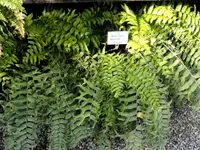
giant swordfern
Nephrolepis biserrata
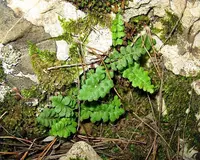
Asplenium petrarchae
Asplenium petrarchae
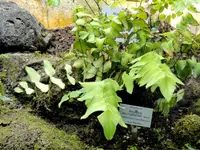
largeleaf maidenhair
Adiantum macrophyllum
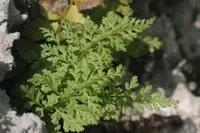
alpine bladder-fern
Cystopteris alpina
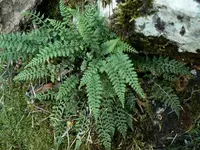
Smooth rock spleenwort
Asplenium fontanum
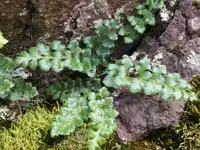
Asplenium pleurosorum
Asplenium pleurosorum
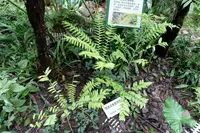
Angiopteris fokiensis
Angiopteris fokiensis

Oriental vessel fern
Angiopteris evecta