


Rotate For Symmetry
Turn the pot 90° every 2–3 weeks during active growth so the ribs remain evenly lit and the stem stays cylindrical instead of leaning toward the strongest light source.

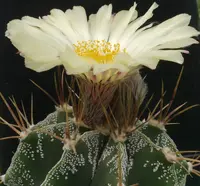
Bishop's hat (Astrophytum ornatum) is a slow-growing desert cactus known for its tall ribbed stem, white flecks, and occasional yellow, daisy-like flowers. It forms a single, upright column rather than branching clusters.
This species is native to arid regions of central Mexico, where it grows on rocky slopes with intense sun and very low rainfall. Its thick skin and water-storing tissues make it drought tolerant but sensitive to excess moisture.
In cultivation, it stays compact for many years, which suits windowsills and small collections. Understanding how to care for bishop's hat mainly involves giving strong light, fast-draining soil, and careful, infrequent watering.

Care Difficulty
Moderate Care

Light Preference
Full Sun

Water Requirements
Low Water

Temperature Preference
Tropical / Frost Sensitive

Hardiness Zone
10–11

Soil Texture
Sandy, Rocky, Loamy

Soil pH
Slightly acidic (6.5–7.0), Neutral (7.0)

Soil Drainage
Well-drained

Fertilization
Minimal (feed rarely)
Scan your plant to receive care tips personalized for your specific plant
Available on iOS and Android
Astrophytum ornatum prefers bright, mostly direct sun with some protection at the hottest times of day.
Astrophytum ornatum needs sparse, carefully timed watering suited to a desert cactus.
This cactus prefers warm, dry conditions and dislikes prolonged cold or damp.
Astrophytum ornatum handles dry indoor air well, so humidity is rarely a concern for this cactus.
Astrophytum ornatum prefers a very fast-draining, mineral-based substrate to protect its roots from rot.
This species is well suited to container growing.
Astrophytum ornatum benefits from light, controlled feeding during its active growing season.
Pruning needs for Astrophytum ornatum are minimal and mainly corrective.
This cactus prefers infrequent repotting with minimal root disturbance.
Astrophytum ornatum is primarily propagated from seed, as it seldom offsets.
Winter care is important since this cactus is not reliably hardy in freezing climates.

Plant Health Check
Not sure what's wrong with your plant? Check your plant's health inside the app.
As the plant matures, its straight vertical ribs often twist into a gentle spiral, a trait especially pronounced in older wild plants from central Mexico.
The star-like pattern comes from large, closely spaced areoles that produce thick white wool, which helps shield the stem from intense sunlight in its native semi-desert habitat.
This species naturally occurs on rocky limestone slopes in central Mexico, where it grows in shallow, alkaline soils and often anchors among fractured rock to avoid erosion.

In habitat, some individuals have been observed living for many decades and can slowly reach more than 1 m tall, making this one of the tallest and longest-lived species in the genus Astrophytum.
Growth is slow. Seedlings often stay under 2.5 cm for the first year, then add about 1–3 cm in height per year. Good light, warm temperatures, and sparse but regular watering help grow Astrophytum ornatum efficiently.
Keep your plants happy and healthy with plant identification, disease detection, and easy care guidance.

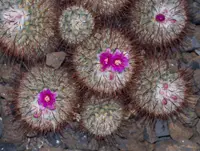
Silken Pincushion Cactus
Mammillaria bombycina
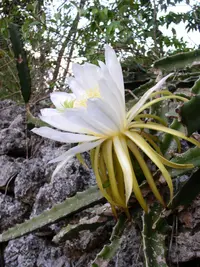
Strawberry Pear
Selenicereus triangularis
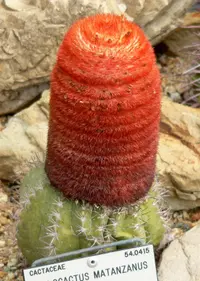
Dwarf turk's cap cactus
Melocactus matanzanus
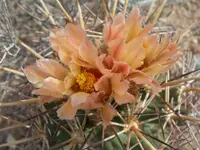
Pima Pineapple Cactus
Coryphantha robustispina
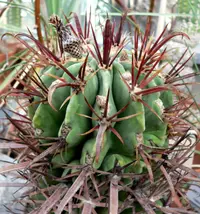
Devil's Tongue Barrel Cactus
Ferocactus latispinus
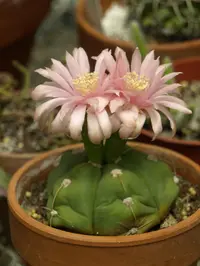
Cactus
Gymnocalycium horstii
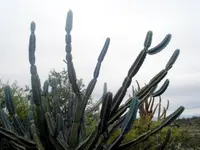
Cereus forbesii
Cereus forbesii
Goat's Horn Cactus
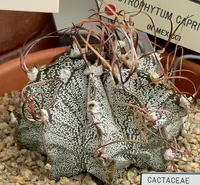
Astrophytum capricorne