Windbreak placement
Site plants where they can serve as a windbreak, spacing them 1–1.5 m apart in staggered rows to create dense, salt-tolerant shelter for more sensitive plants downwind.

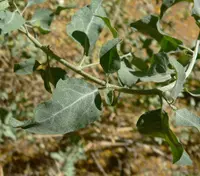
Big saltbush, Atriplex lentiformis, is a hardy evergreen shrub native to arid and coastal regions of the southwestern United States and northern Mexico. It is often used in windbreaks, erosion control, and habitat plantings.
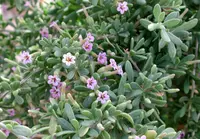
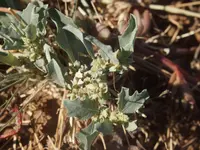
The plant forms dense, branching thickets with gray-green, slightly scaly leaves that tolerate wind, salt spray, and poor, alkaline soils. Its small, inconspicuous flowers develop into dry seed clusters that provide food and cover for wildlife.
Big saltbush is adapted to full sun, low rainfall, and well-drained soils, which makes it suitable for low-maintenance, drought-tolerant landscapes. Understanding these natural adaptations helps guide how to care for big saltbush in cultivated settings.

Care Difficulty
Easy Care

Light Preference
Full Sun

Water Requirements
Low Water

Temperature Preference
Warm Climate

Hardiness Zone
8–11

Soil Texture
Sandy, Loamy, Rocky

Soil pH
Neutral (7.0), Alkaline (7.5–8.5)

Soil Drainage
Well-drained

Fertilization
Minimal (feed rarely)
Scan your plant to receive care tips personalized for your specific plant
Available on iOS and Android
This desert shrub thrives in strong sun but adapts to a range of bright conditions.
This salt-tolerant shrub prefers dry to moderately dry conditions once established.
This species is adapted to hot, arid climates with a wide temperature tolerance.
This species is highly tolerant of dry air and usually does not need humidity adjustment.
Atriplex lentiformis prefers very well-drained, mineral, often saline soils with low organic content.
This species can be grown in large containers outdoors, but only when the pot can support its vigorous, woody growth.
This salt-tolerant shrub is adapted to poor soils and usually needs little to no fertilizer once established.
Pruning helps keep Atriplex lentiformis dense, manageable, and healthy in landscape settings.
This species is usually grown in-ground, so care focuses on successful transplanting rather than frequent repotting.
Atriplex lentiformis is commonly propagated from seeds or semi-hardwood cuttings for restoration and landscape use.
This shrub is generally cold hardy in its range and usually needs minimal winter care in the ground.

Plant Health Check
Not sure what's wrong with your plant? Check your plant's health inside the app.
This species can grow in soils with high salt levels and even helps remove salt from the soil by storing it in its leaves, which later fall and can be washed away. Its leaf cells compartmentalize salt into special vacuoles, allowing normal photosynthesis to continue despite saline conditions.
In its native southwestern US and northern Mexico range, this shrub forms dense thickets that provide shelter and nesting sites for birds such as quail and sparrows. Many mammals and insects also use it as cover and a local food source, especially in arid floodplains.
Big saltbush often grows along dry washes, saline flats, and disturbed ground, where its deep and wide root system helps stabilize loose, erosion-prone soils. Land managers sometimes use it in restoration projects to reclaim degraded, salty sites.

Big saltbush can tolerate soil salinities similar to those found in seawater, which makes it one of the dominant shrubs in some highly saline desert wetlands and an important model species in research on halophytes, plants that are naturally adapted to live in salty environments.
This shrub can spread widely by seed and natural layering, especially in coastal or saline soils. In managed landscapes it is usually controlled with spacing, pruning, and removal of unwanted seedlings before they establish dense thickets.
Keep your plants happy and healthy with plant identification, disease detection, and easy care guidance.