


Host tree selection
Establish this mycorrhizal fungus near compatible broadleaf hosts such as oaks, beeches, or chestnuts, as fruiting is unlikely without a healthy, mature partner tree already in place.

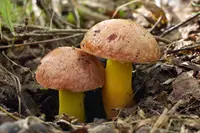
The gilded bolete, Aureoboletus gentilis, is a mycorrhizal fungus, not a leafy plant. It forms a mushroom with a golden to yellow cap and a pore surface instead of gills. The stalk is usually slender and often matches the warm tones of the cap.
This species is found mainly in woodlands of Europe and parts of Asia, growing on soil in association with trees. It is considered uncommon in cultivation because it depends on living tree roots, so it is not suited to typical indoor pot culture. Those who try to care for Gilded Bolete must recreate woodland conditions with suitable host trees, moist but well-drained soil, and shade.

Care Difficulty
Moderate Care

Light Preference
Partial Shade

Water Requirements
Regular Water

Temperature Preference
Cool Climate

Hardiness Zone
Unknown

Soil Texture
Loamy, Silty, Organic-rich

Soil pH
Acidic (5.5–6.5), Slightly acidic (6.5–7.0)

Soil Drainage
Moist but well-drained

Fertilization
Minimal (feed rarely)
Scan your plant to receive care tips personalized for your specific plant
Available on iOS and Android
This mycorrhizal fungus prefers mild woodland light rather than open, exposed sun.
This woodland species depends on consistently moist, not saturated, soil around its tree partners.
This species favors mild, temperate woodland conditions and is sensitive to both hard frost and intense heat.
This ectomycorrhizal fungus prefers moderately moist air but is not highly humidity-sensitive outdoors.
Aureoboletus gentilis fruits best in loose, humus-rich forest-type soil with consistent moisture and strong drainage.
This species is generally unsuitable for container growing because it relies on complex root and soil relationships in the ground.
This mycorrhizal fungus grows with trees and normally needs no added fertilizer in natural or woodland-style plantings.
Aureoboletus gentilis does not require horticultural pruning, as the visible mushroom is only the fruiting body of an underground fungus.
This species is not suited to normal repotting; it lives on tree roots and is best left undisturbed in the ground.
Practical home propagation of Aureoboletus gentilis is difficult because it depends on a stable mycorrhizal partnership with suitable host trees.
This woodland fungus is naturally cold hardy in its native range and usually needs no special winter care.

Plant Health Check
Not sure what's wrong with your plant? Check your plant's health inside the app.
The underside of the cap carries a dense layer of small, bright lemon-yellow pores that do not bruise blue, which helps distinguish this species from many other boletes that show strong blue staining when injured.
This species forms ectomycorrhizal partnerships with broadleaf trees, especially oaks (Quercus spp.), exchanging mineral nutrients and water for sugars from the host tree’s roots.
The specific epithet gentilis refers to its relatively soft, delicate tissue and mild, non-bitter taste, which contrasts with the firmer or more strongly flavored flesh of many related boletes.
This bolete is generally regarded as inedible due to its slimy cap and poor texture, not because of strong toxicity. Identification of wild fungi is complex; mushrooms should only be eaten when confirmed by an expert mycologist.
Keep your plants happy and healthy with plant identification, disease detection, and easy care guidance.

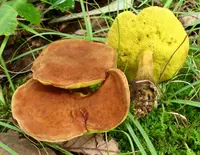
clustered brown bolete
Aureoboletus innixus
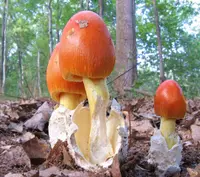
Jackson's slender Caesar
Amanita jacksonii
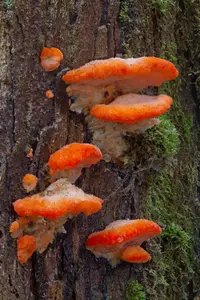
Strawberry Bracket
Aurantiporus pulcherrimus
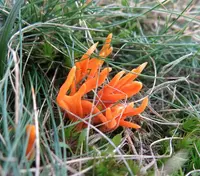
Apricot Club
Clavulinopsis luteoalba
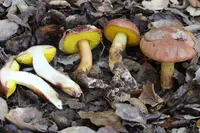
viscid bolete
Aureoboletus flaviporus
Brown cobblestone lichen
Acarospora fuscata
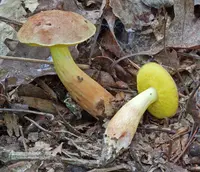
sour gold-pored bolete
Aureoboletus auriporus
skirt webcap
Austrocortinarius australiensis