Host tree selection
Establish this ectomycorrhizal fungus near suitable host trees such as eucalypts or related native species, since fruiting is far more reliable where fine feeder roots are dense and undisturbed.

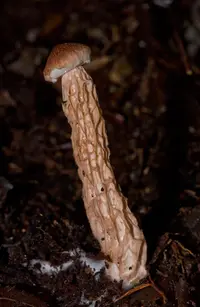
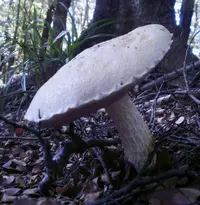
Flecked bolete, Austroboletus lacunosus, is a mycorrhizal mushroom that forms a symbiotic relationship with tree roots rather than growing as a typical garden plant. It produces thick, pale to tan caps with a spongy underside and a characteristically pitted, often flecked stem.
This species is native to Australia and nearby regions, usually appearing on the ground in forests with eucalypts or other native trees. It relies on its host trees and natural soil fungi, so it is difficult to cultivate and not suited to standard pot or bed culture.
Those who want to care for Flecked bolete in a managed landscape usually focus on maintaining healthy host trees, undisturbed soil, and stable moisture levels in partially shaded woodland settings.

Care Difficulty
Hard Care

Light Preference
Partial Shade

Water Requirements
Keep Soil Moist

Temperature Preference
Warm Climate

Hardiness Zone
Unknown

Soil Texture
Loamy, Sandy, Organic-rich

Soil pH
Acidic (5.5–6.5)

Soil Drainage
Moist but well-drained

Fertilization
Minimal (feed rarely)
Scan your plant to receive care tips personalized for your specific plant
Available on iOS and Android
This mycorrhizal mushroom prefers cool, dappled woodland light rather than direct, exposed sun.
This woodland fungus depends on steady soil moisture rather than frequent surface wetting.
This species performs best in mild, woodland-like temperatures with cool, moist soil.
This mycorrhizal fungus is not suited to controlled indoor humidity and is best left in its natural woodland environment.
This ectomycorrhizal species relies on host tree roots and cannot be maintained in ordinary potting media.
This woodland fungus is not suitable for container cultivation.
This ectomycorrhizal fungus relies mainly on its tree partners and typically needs no direct fertilization in gardens or outdoor habitats.
Pruning is not applicable to Austroboletus lacunosus because it is a mushroom, not a woody or leafy plant.
This fungus is best left undisturbed, as it forms a symbiotic relationship with tree roots and does not adapt well to container culture.
Intentional propagation of Austroboletus lacunosus in home settings is rarely successful and not typically recommended.
This woodland mushroom is naturally cold hardy in its native range and needs no special winter care in the landscape.

Plant Health Check
Not sure what's wrong with your plant? Check your plant's health inside the app.
This species has a characteristically deeply pitted and ridged stem surface, giving it a honeycombed or lacunose appearance that helps separate it from many other boletes in the field.
It forms ectomycorrhizal associations with eucalypts in Australia, exchanging mineral nutrients and water from the soil for sugars from the tree roots in dry sclerophyll and woodland habitats.
Unlike many boletes that develop yellow or olive pores, this species typically shows a whitish to pale pore surface that does not bruise blue, which is a useful identification character for Austroboletus lacunosus care instructions in mushroom-friendly gardens.
This species is generally regarded as inedible due to its tough texture and poor culinary quality, not because of strong toxins. For safety, avoid consuming wild specimens unless identified and assessed by a qualified local mycologist.
Keep your plants happy and healthy with plant identification, disease detection, and easy care guidance.