Mycelium-Friendly Handling
Minimize soil disturbance and foot traffic over the colonized area; compaction damages the underground mycelium network and directly reduces future fruiting.

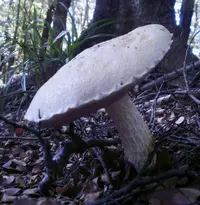
The snowy bolete, Austroboletus niveus, is a mycorrhizal fungus that forms a partnership with tree roots rather than a traditional leafy plant. It produces thick, pale to white caps with a spongy pore surface underneath, supported by sturdy stalks. In nature it occurs in forested areas, often in warm or subtropical regions. Its growth depends on compatible host trees and suitable soil fungi communities, which makes it difficult to cultivate at home. It generally prefers shaded woodland conditions with consistent moisture and well-drained, organically rich soil. For most home growers, it is more practical to appreciate than to actively care for snowy bolete.

Care Difficulty
Hard Care

Light Preference
Partial Shade

Water Requirements
Keep Soil Moist

Temperature Preference
Warm Climate

Hardiness Zone
Unknown

Soil Texture
Loamy, Organic-rich

Soil pH
Acidic (5.5–6.5)

Soil Drainage
Moist but well-drained

Fertilization
Minimal (feed rarely)
Scan your plant to receive care tips personalized for your specific plant
Available on iOS and Android
This ectomycorrhizal fungus prefers woodland light conditions that mimic a dappled forest floor.
This species relies on consistently moist, well‑drained forest soil rather than a strict watering schedule.
This fungus performs best in mild, woodland-like temperatures without strong extremes.
This fungus prefers moderately moist, well-ventilated conditions rather than consistently high humidity.
Austroboletus niveus depends on loose, aerated ground conditions rather than compact, waterlogged soil.
This species is generally unsuitable for container growing because it relies on complex soil and root partnerships that are difficult to maintain in pots.
This ectomycorrhizal fungus relies mainly on its tree partner for nutrients, so the snowy bolete needs no direct fertilization.
Pruning is not applicable to Austroboletus niveus, as it is a fleshy mycorrhizal mushroom rather than a woody or leafy plant.
Transplanting focuses on the host tree and soil community rather than the fungus itself, which forms fine mycelial networks in the ground.
Propagation of Austroboletus niveus is specialized and not typically attempted by home growers, because it depends on complex mycorrhizal relationships.
In climates where it is native and grown in the ground, this fungus is generally cold hardy and needs no targeted winter care.

Plant Health Check
Not sure what's wrong with your plant? Check your plant's health inside the app.
The cap of this bolete is characteristically whitish to very pale cream and often develops a fine, powdery or frosted surface, which is unusual among mostly brown or brightly colored boletes.
Instead of gills, it has a spongy pore surface that starts pale and can develop pinkish tones with age, a useful field character that helps separate it from look‑alike white boletes.
This species forms ectomycorrhizal associations, a mutualistic root partnership with certain trees, trading mineral nutrients and water from the soil for sugars produced by its host via photosynthesis.
This fungus is generally regarded as inedible, mainly due to poor texture and limited culinary value rather than strong toxicity. Identification errors with white boletes can be risky, so avoid consumption unless confirmed by an experienced mycologist.
Keep your plants happy and healthy with plant identification, disease detection, and easy care guidance.