Use hardwood chunks
When establishing a patch, half-bury small, partially decayed hardwood chunks (especially oak or beech) in a shady, moist bed, as this gives the fungus a stable substrate to colonize over several seasons.

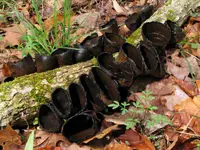
Devil's urn, Urnula craterium, is a cup fungus rather than a typical leafy plant. It forms dark, urn-shaped cups that emerge from decaying hardwood, often in early spring. The fruiting bodies sit low to the ground and blend into leaf litter, giving them a subtle, almost charcoal-like appearance. This species is native to temperate forests in North America and parts of Europe. It relies on cool, moist woodland conditions and well-rotted wood, which makes it challenging to cultivate outside a natural-like setting. Those who want to learn how to care for devil's urn usually focus on recreating a shaded, consistently damp, humus-rich environment.

Care Difficulty
Moderate Care

Light Preference
Partial Shade

Water Requirements
Regular Water

Temperature Preference
Cool Climate

Hardiness Zone
4–8

Soil Texture
Loamy, Silty, Organic-rich

Soil pH
Acidic (5.5–6.5), Slightly acidic (6.5–7.0)

Soil Drainage
Moist but well-drained

Fertilization
Minimal (feed rarely)
Scan your plant to receive care tips personalized for your specific plant
Available on iOS and Android
This fungus prefers cool, shaded woodland conditions rather than strong direct sun.
This species thrives in consistently moist, not saturated, woodland soil and leaf litter.
This fungus is adapted to cool temperate climates and fruits mainly in late winter to spring.
Humidity is not a primary factor for Urnula craterium, which relies more on consistently moist, cool substrates.
This fungus prefers moist, cool, organic-rich forest soil with steady drainage and airflow.
This species is generally unsuitable for container growing because it depends on complex woodland soil conditions and decaying organic layers.
This fungus grows on decaying wood and usually needs no additional fertilizer in natural or garden settings.
Urnula craterium requires no true pruning, since the visible cups are short-lived fungal fruiting bodies rather than branches or stems.
Transplanting is rarely practical because this fungus depends on specific decaying hardwood and soil conditions.
Deliberate propagation of this fungus is challenging and not typically attempted by home growers.
This species is naturally cold hardy in woodland climates and does not need special winter care.

Plant Health Check
Not sure what's wrong with your plant? Check your plant's health inside the app.
This species is one of the earliest cup fungi to appear in late winter to early spring, often fruiting while snow is still on the ground and signaling the start of the mushroom season in many temperate forests.
It is a saprobic fungus, meaning it feeds on dead organic matter, and it is most often found decomposing fallen hardwood branches and sticks, especially oak, helping recycle nutrients back into the forest soil.
The fruiting body develops a dark, nearly black inner surface with a rough, urn-like outer wall, a combination of features that makes it one of the more easily recognized members of the order Pezizales in the field.

Molecular studies using DNA sequencing have supported placing this species within the family Sarcosomataceae, helping clarify its relationships among the cup fungi after earlier classifications based mainly on external shape and spore features.
This fungus grows best outdoors in cool, temperate woodlands on decaying hardwood. It does not adapt well to typical home conditions, so devil's urn indoor care is rarely successful or recommended.
Keep your plants happy and healthy with plant identification, disease detection, and easy care guidance.