Mimic natural substrate
Mount the lichen on a piece of weathered bark, stone, or compacted sandy grit rather than standard potting mix, as this mimics its natural habitat and improves long‑term stability.

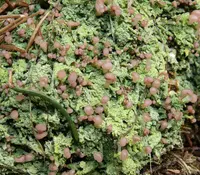
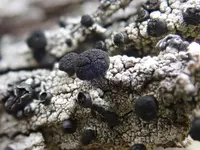
Cap lichen, Baeomyces rufus, is a crustose lichen rather than a true vascular plant. It forms low, crusty mats with tiny pink to red cap-like fruiting bodies. These colonies spread slowly across soil, rock, or rotting wood. The overall look is compact, with muted gray-green or whitish thalli supporting the colored caps.
This lichen is common in cool, temperate regions, often in open, acidic habitats such as heaths, sandy banks, and exposed forest floors. It grows very slowly and is sensitive to pollution and disturbance, which makes it challenging to cultivate. Those who want to learn how to care for cap lichen should focus on stable, undisturbed conditions with clean air, moderate light, and evenly moist but well-drained, low-nutrient substrates.

Care Difficulty
Hard Care

Light Preference
Partial Shade

Water Requirements
Low Water

Temperature Preference
Cold Hardy

Hardiness Zone
3–9

Soil Texture
Rocky, Sandy

Soil pH
Strongly acidic (4.5–5.5)

Soil Drainage
Well-drained

Fertilization
Minimal (feed rarely)
Scan your plant to receive care tips personalized for your specific plant
Available on iOS and Android
This crustose lichen prefers cool, open sites with steady but gentle light exposure.
This lichen relies on natural wetting and drying cycles rather than regular, heavy watering.
This species is cold-hardy and tolerates a wide temperature range when attached to stable rock or soil.
This lichen prefers cool, constantly moist air rather than typical indoor humidity control.
This species grows best on very lean, acidic, and well-drained mineral substrates rather than rich potting mixes.
This lichen can be grown in shallow containers mainly as a microhabitat display rather than a conventional potted plant.
Baeomyces rufus, a cap lichen, is adapted to very low nutrient environments and generally should not be fertilized.
Pruning Baeomyces rufus is rarely necessary and is mainly done for appearance or to manage space.
Transplanting Baeomyces rufus is delicate, since the lichen forms tight associations with its substrate and grows very slowly.
Propagation of Baeomyces rufus is slow and technically challenging, so it is not commonly attempted at home.
This lichen is naturally cold hardy and usually needs no special winter care in outdoor conditions.

Plant Health Check
Not sure what's wrong with your plant? Check your plant's health inside the app.
This species produces small, rounded pink to red apothecia (spore-producing structures) that look like tiny match heads or bubblegum grains on top of a granular crust. The contrasting colors make it easy to distinguish from many other soil and rock lichens in the field.
It strongly favors acidic, nutrient-poor substrates such as siliceous rocks, peaty soil, and exposed tree roots. Its presence is often used by lichenologists as a field indicator of low pH and low nutrient availability in a site.
This lichen readily colonizes disturbed, eroded, or newly exposed surfaces, helping to stabilize soil and initiate biological crusts. Over time, its crust-like thallus traps particles and organic matter, contributing to the development of early-stage soils.

Baeomyces rufus is remarkably tolerant of cold and occurs from lowland temperate regions up into subalpine and arctic environments, where it can resume photosynthesis rapidly after thawing from frozen or desiccated (dried-out) conditions.
This species grows very slowly, often only fractions of a millimeter to a few millimeters per year. Growth rate depends on stable moisture, clean air, cool temperatures, and undisturbed substrate such as rock, compact soil, or rotting wood.
Keep your plants happy and healthy with plant identification, disease detection, and easy care guidance.