


Use aquatic baskets
Plant clumps in mesh aquatic baskets lined with hessian or fine fabric so roots can spread in saturated media while allowing easy lifting, division, and control in ponds or bog gardens.

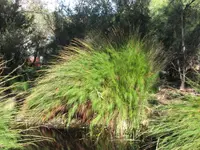
Baloskion tetraphyllum, commonly called tassel cord-rush, is a slender, rush-like wetland plant native to eastern Australia. It forms dense clumps of upright, thread-like green stems with soft tassel-like tips.
In the wild it grows along stream edges, in bogs, and other consistently moist, acidic sites. It suits naturalistic ponds, water gardens, and container water features.
This species prefers cool to mild conditions, constant moisture, and low-nutrient, sandy or peaty substrates. Light wind protection helps prevent stems from lodging.
It is moderately demanding under garden conditions, mainly because it dislikes drying out or overheating, so learning how to care for tassel cord-rush focuses on stable moisture and climate.

Care Difficulty
Hard Care

Light Preference
Partial Shade

Water Requirements
Aquatic

Temperature Preference
Cool Climate

Hardiness Zone
8–10

Soil Texture
Sandy, Loamy, Peaty

Soil pH
Strongly acidic (4.5–5.5), Acidic (5.5–6.5)

Soil Drainage
Waterlogged tolerant

Fertilization
Minimal (feed rarely)
Scan your plant to receive care tips personalized for your specific plant
Available on iOS and Android
This wetland rush prefers bright, gentle light that mimics open, boggy habitats.
This species is adapted to consistently wet, even boggy conditions rather than alternating wet‑dry cycles.
This rush prefers mild, cool to warm conditions and is sensitive to hard freezing and extreme heat.
This wetland rush needs very high humidity to stay healthy in cultivation.
This species prefers saturated, organic, marsh-like soil conditions rather than typical houseplant mixes.
This rush can be grown in containers if the pot is managed to imitate bog or streamside conditions.
Baloskion tetraphyllum prefers low-nutrient conditions, so use light feeding to support growth in containers.
Baloskion tetraphyllum needs minimal pruning, mainly to keep clumps healthy and tidy.
This species is usually grown in boggy beds or pond margins, so focus on careful transplanting when needed.
Baloskion tetraphyllum is typically propagated by division or from fresh seed under controlled moist conditions.
This plant prefers mild, frost-free climates and benefits from some winter protection in colder regions.

Plant Health Check
Not sure what's wrong with your plant? Check your plant's health inside the app.
This tassel cord-rush belongs to a group of southern hemisphere plants whose ancestors date back to the Gondwana supercontinent, and many related species are still concentrated in Australia and nearby regions.
In the wild it typically forms dense stands along cool, clean, slow-flowing streams and soaks, where its fibrous roots help stabilize banks and trap fine sediments.
Although it looks like a true rush, it is placed in the family Restionaceae, a distinct group of grass-like plants that often replaces grasses and sedges in nutrient-poor, acidic wetlands.

Some populations of this species are used in ecological restoration projects in southeastern Australia, where its dense clumps are planted along degraded waterways to improve bank stability, reduce erosion, and create shelter for aquatic and semi-aquatic invertebrates.
Brown tips or stems usually result from low moisture around the roots, prolonged drought, or hot, drying winds. Check that the root zone stays consistently damp, avoid letting containers dry out fully, and provide some wind protection.
Keep your plants happy and healthy with plant identification, disease detection, and easy care guidance.

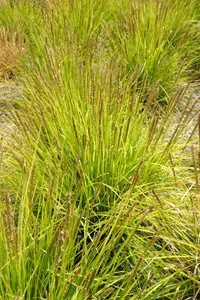
Autumn moor grass
Sesleria autumnalis
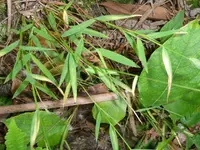
Pogonatherum crinitum
Pogonatherum crinitum

big bluestem
Andropogon gerardi
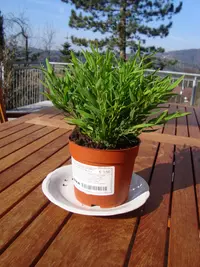
Pogonatherum paniceum
Pogonatherum paniceum

broomsedge bluestem
Andropogon virginicus
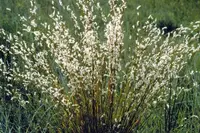
little bluestem
Schizachyrium scoparium
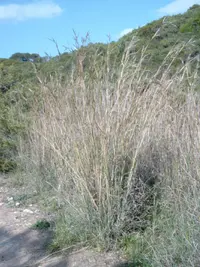
Mountain Andropogon
Andropogon distachyos
Elliott's bluestem
Andropogon gyrans