Early trellis training
Install a sturdy trellis or horizontal wire frame when the vine is still young, then loosely tie new shoots with soft garden ties so the plant learns its long-term growth direction and does not tangle or kink.

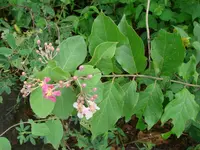
Banisteriopsis muricata is a perennial woody vine native to tropical South America, typically found in lowland rainforest and secondary forest edges. It belongs to the Malpighiaceae family, the same group as several other liana-forming species.
The plant climbs by twining stems, forming long, flexible vines with simple, opposite leaves and small, often inconspicuous flowers. In cultivation it is usually grown for its ethnobotanical interest rather than for showy ornamental value.
It can be challenging to maintain outside tropical or subtropical climates, as it prefers consistently warm conditions, high humidity, and a sheltered position. Understanding how to care for Banisteriopsis muricata starts with providing well-drained, humus-rich soil and protection from cold or very dry air.

Care Difficulty
Hard Care

Light Preference
Partial Shade

Water Requirements
Regular Water

Temperature Preference
Tropical / Frost Sensitive

Hardiness Zone
Unknown

Soil Texture
Loamy, Organic-rich

Soil pH
Acidic (5.5–6.5)

Soil Drainage
Moist but well-drained

Fertilization
Minimal (feed rarely)
Scan your plant to receive care tips personalized for your specific plant
Available on iOS and Android
This tropical liana prefers bright, filtered sun that mimics light edges of rainforest clearings.
This species prefers consistently moist but not saturated soil, with careful attention to drainage.
This vine thrives in warm, frost-free conditions that resemble a humid, lowland tropical climate.
This liana prefers consistently humid air similar to a warm rainforest edge.
This species performs best in a loose, well‑structured mix that drains freely yet retains moderate moisture.
This species adapts well to container growing when the pot supports its climbing, woody habit.
This vigorous tropical liana benefits from light, balanced feeding in cultivation, especially in containers.
Thoughtful pruning keeps this twining vine manageable, encourages branching, and maintains flowering wood.
This species can be container-grown when young but is usually better established in open ground for long-term vigor.
This woody climber is typically propagated from semi-ripe cuttings or seeds under warm, humid conditions.
This tropical vine is frost-sensitive and needs protection wherever temperatures drop near or below 32°F.

Plant Health Check
Not sure what's wrong with your plant? Check your plant's health inside the app.
This woody vine is native to lowland and foothill rainforests of the western and central Amazon basin, where it climbs into the forest canopy using twining stems that can reach several meters in length.
Although often confused with the related ayahuasca vine Banisteriopsis caapi, this species differs in details of stem surface, leaf shape, and inflorescence structure, and botanists separate them based on those consistent morphological traits.
As a canopy-climbing liana, it contributes to forest connectivity by linking tree crowns, which can influence light patterns, provide pathways for arboreal animals, and increase mechanical load on host trees over time.
This species is a woody liana, meaning it climbs rather than creeping along the ground. It twines around nearby trees, trellises, or wires and needs vertical structures to develop its full length and characteristic vine form.
Keep your plants happy and healthy with plant identification, disease detection, and easy care guidance.