Provide climbing support
Install a sturdy trellis, wire mesh, or horizontal netting before the new shoots emerge in spring so the vines can be gently tied and guided as they grow, preventing stem breakage and tangled growth.

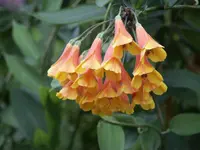
The trailing lily, Bomarea multiflora, is a twining, clambering climber grown for its clusters of tubular, lily-like flowers. Stems can weave through supports, hanging or scrambling with a loose, trailing habit.
In the wild it is native to mountainous regions of Central and South America, where it grows in cool, moist forests. Flowers often appear in dense umbels with warm orange, red, or yellow tones, giving a tropical look.
This species can be challenging, as it prefers stable, mild temperatures, consistent moisture, and good drainage, and it dislikes extremes. Gardeners who care for trailing lily best provide bright, filtered light and a cool, protected position.

Care Difficulty
Hard Care

Light Preference
Partial Shade

Water Requirements
Keep Soil Moist

Temperature Preference
Tropical / Frost Sensitive

Hardiness Zone
9–11

Soil Texture
Loamy, Silty, Organic-rich

Soil pH
Acidic (5.5–6.5), Slightly acidic (6.5–7.0)

Soil Drainage
Moist but well-drained

Fertilization
Light (every 4–6 weeks)
Scan your plant to receive care tips personalized for your specific plant
Available on iOS and Android
This twining climber prefers bright but gentle light that mimics a forest edge or open woodland.
This tuberous climber needs steadily moist but not waterlogged soil throughout the growing season.
This species grows best in mild, frost-free climates with cool to warm, stable temperatures.
This species prefers moderately high, stable humidity to support lush, healthy growth.
This species grows best in loose, moist, well-drained soil that mimics a rich forest edge or mountainside.
This climber is suitable for container growing when given enough depth and support.
Bomarea multiflora responds well to moderate, balanced feeding during its active growing season.
Pruning Bomarea multiflora is mainly used to manage growth and maintain flowering performance.
Container-grown plants benefit from careful transplanting when growth slows or roots crowd the pot.
Bomarea multiflora is typically propagated by division of tuberous roots or by seed under controlled conditions.
Cold sensitivity requires specific winter care for Bomarea multiflora in many climates.

Plant Health Check
Not sure what's wrong with your plant? Check your plant's health inside the app.
This species is native to cool, moist Andean cloud forests from Colombia to Peru, where it scrambles through shrubs and small trees rather than behaving like a typical ground-dwelling lily.
Its inflorescences form dense umbels with many small tubular flowers, creating a ball-like cluster that is highly visible to pollinators in the dim light of montane forests.
The brightly colored, nectar-rich flowers are adapted to bird pollination, especially by hummingbirds that can hover and access the narrow, pendant blooms efficiently.

Bomarea multiflora often shares its montane habitat with epiphytic plants and mosses, using the same woody supports but relying on tendrils and twining stems rather than roots to climb into higher, better-lit layers of the forest.
Lack of flowers usually comes from insufficient light, cool temperatures, or poor nutrition. Ensure bright conditions, avoid heavy nitrogen fertilizer, and provide a short dry rest after active growth to help reset the flowering cycle.
Keep your plants happy and healthy with plant identification, disease detection, and easy care guidance.