Mounting orientation
Mount plants at a 30–60° angle with the tips pointing slightly downward so water can drain off the base quickly after misting or fogging, which reduces rot in compact clumps.

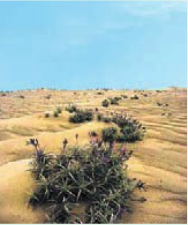
Tillandsia landbeckii is a small atmospheric air plant that absorbs moisture and nutrients directly from the air through specialized leaf scales called trichomes. It usually forms slender, branched clumps with narrow gray-green leaves and a wiry, sculptural look.
This species occurs naturally in very arid, high-altitude regions of Chile and Peru, where it survives extreme dryness and strong light. Its slow growth and drought tolerance make it resilient but a bit sensitive to overhandling and excess moisture in cultivation.
Understanding how to care for Tillandsia landbeckii starts with providing strong light, very good air movement, and only light, occasional hydration rather than frequent soaking or misting.

Care Difficulty
Hard Care

Light Preference
Full Sun

Water Requirements
Low Water

Temperature Preference
Warm Climate

Hardiness Zone
Unknown

Soil Texture
Rocky, Sandy

Soil pH
Slightly acidic (6.5–7.0)

Soil Drainage
Well-drained

Fertilization
Minimal (feed rarely)
Scan your plant to receive care tips personalized for your specific plant
Available on iOS and Android
This species thrives in bright, open conditions but is sensitive to intense, scorching sun.
This atmospheric species absorbs moisture through its leaves, so watering focuses on humidity and brief wetting, not constant soaking.
This high-elevation air plant prefers cool to mild temperatures and dislikes both hard frost and extreme heat.
This species prefers moderately dry air with steady conditions rather than high humidity.
Tillandsia landbeckii is an air plant and should not be grown in conventional soil.
This species can be grown in containers only as a mounted or supported air plant, not planted in potting mix.
This epiphytic air plant grows well with very light feeding, mainly during its active season.
This species needs minimal pruning, focused on hygiene and maintaining an open clump structure.
As an air plant, this species is not truly repotted but can be remounted or repositioned when overcrowded or declining.
Propagation is commonly done by division of offsets rather than from seed, which is slower and less predictable.
This air plant dislikes hard frost and benefits from simple protection in cold climates.

Plant Health Check
Not sure what's wrong with your plant? Check your plant's health inside the app.
This species grows in some of the driest parts of the Atacama Desert, where it survives almost entirely on coastal fog (camanchaca) rather than rainfall, absorbing water directly through specialized leaf scales called trichomes.
Plants often form dense, tangled mats that lie on loose desert substrates with little or no functional root system, relying on their leaves for both water and nutrient uptake instead of using roots to access soil resources.
It spends much of the year in a dry, dormant-like state with highly reduced metabolic activity, an adaptation that allows survival in a hyper-arid climate where multi-year rainfall can be close to zero.

Field studies have shown that this species can act as a natural fog collector, with its mats intercepting and condensing airborne moisture in such a way that it has been used as a model organism for designing artificial fog-harvesting systems in arid regions.
This species often needs to reach a certain age and size before flowering. Blooming is more likely after a period of stable conditions and a slight seasonal temperature or daylength change that signals its natural flowering season.
Keep your plants happy and healthy with plant identification, disease detection, and easy care guidance.