Protect dormant crowns
Mark the location of the underground crowns with discreet stakes or stones in late summer so winter mulching, weeding, or foot traffic does not disturb or compact the tiny growing points.

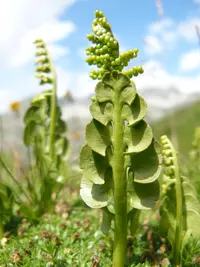
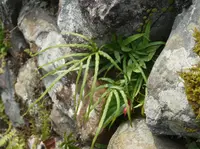
Common moonwort, Botrychium lunaria, is a small, short-lived fern found in open, often cool habitats such as meadows, rocky slopes, and coastal grasslands. It belongs to a primitive fern group known for simple structure rather than lush foliage.
This plant typically has a single, upright, fleshy stem with a fan-like frond divided into rounded, moon-shaped segments and a separate fertile spike carrying spores. It often appears sparsely in the landscape and can disappear from view in unfavorable seasons.
Common moonwort is considered challenging to cultivate because it relies on specific soil fungi, undisturbed ground, and stable moisture. Gardeners who try to care for common moonwort usually treat it as a specialist plant rather than a general ornamental.

Care Difficulty
Hard Care

Light Preference
Partial Shade

Water Requirements
Keep Soil Moist

Temperature Preference
Cold Hardy

Hardiness Zone
3–7

Soil Texture
Loamy, Silty, Organic-rich

Soil pH
Acidic (5.5–6.5), Slightly acidic (6.5–7.0)

Soil Drainage
Moist but well-drained

Fertilization
Minimal (feed rarely)
Scan your plant to receive care tips personalized for your specific plant
Available on iOS and Android
This fern-like species prefers cool, subdued light similar to moist meadows and open woodland edges.
Botrychium lunaria prefers consistently moist, cool soil without prolonged saturation.
This temperate fern thrives in cool to mild climates and tolerates cold winters when established outdoors.
This fern prefers steady, cool, moderately moist air rather than very dry or very humid conditions.
Soil for Botrychium lunaria should mimic a cool, moist, well‑aerated woodland floor.
This species can be grown in containers, but it stays healthier in cool, deep, stable pots that maintain consistent moisture.
Botrychium lunaria is adapted to low-nutrient soils and usually needs no fertilization in gardens or containers.
Botrychium lunaria needs almost no pruning, as each frond is short-lived and naturally replaced.
Transplanting common moonwort is challenging because it depends on delicate root–fungus partnerships in stable soil.
Propagation of Botrychium lunaria is highly specialized and rarely successful in typical home or garden settings.
This fern is naturally cold hardy in its native range and usually needs no special winter protection in the ground.

Plant Health Check
Not sure what's wrong with your plant? Check your plant's health inside the app.
This species has a microscopic, non-photosynthetic gametophyte stage that lives entirely underground, relying on symbiotic mycorrhizal fungi for nutrition instead of producing its own sugars.
The sterile frond has thick, fleshy leaf segments shaped like small half-moons, a feature that gives the plant its common name, common moonwort, and helps distinguish it from many other Botrychium species.
In nature this fern often occupies open, well-drained grasslands, subalpine meadows, and coastal dunes in cool-temperate regions, where it benefits from relatively low competition and undisturbed soil.

Botrychium lunaria is considered a conservation concern in several European and North American regions because its small, scattered populations are highly sensitive to habitat disturbance, intensive grazing, and land-use change, which can eliminate local colonies for decades.
This fern is naturally slow-growing. Sporelings may take several years before fronds appear above ground, and mature size is usually reached in 3–5 years, depending on soil stability, moisture levels, and minimal disturbance of its roots and fungal partners.
Keep your plants happy and healthy with plant identification, disease detection, and easy care guidance.