rattlesnake fern Care (Botrychium virginianum)

rattlesnake fern

About rattlesnake fern

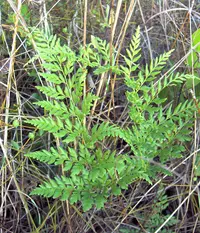
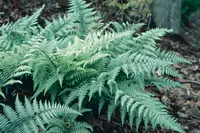
Rattlesnake fern, Botrychium virginianum, is a small woodland fern known for its delicate, divided fronds and a single upright fertile spike that resembles a tiny seed cluster. It grows from a short, fleshy rhizome and appears in spring, often disappearing by late summer in hotter climates.

This species naturally occurs in shaded, moist forests across much of eastern North America, often in rich, humus-based soil. It can be somewhat challenging to establish because it dislikes root disturbance and prefers consistently cool, damp conditions.

For those who want to care for rattlesnake fern, success usually depends on providing stable shade, evenly moist but not waterlogged soil, and protection from heavy foot traffic or digging.

Main Plant Requirements

Care Difficulty

Moderate Care

Light Preference

Partial Shade

Water Requirements

Keep Soil Moist

Temperature Preference

Cold Hardy

Hardiness Zone

3–8

Soil Texture

Loamy, Silty, Organic-rich

Soil pH

Acidic (5.5–6.5), Slightly acidic (6.5–7.0)

Soil Drainage

Moist but well-drained

Fertilization

Minimal (feed rarely)

Get Personalized Care Plan

Scan your plant to receive care tips personalized for your specific plant

Available on iOS and Android

How to Care for the rattlesnake fern

This woodland fern prefers soft, filtered light that mimics a shaded forest floor.

  • Provide bright dappled shade or filtered light with 1–3 hours of early morning sun and no harsh midday or afternoon sun.
  • Site rattlesnake fern under deciduous trees or on the north or east side of structures, where it receives indirect light for 6–8 hours.
  • Watch fronds for stress: pale, scorched, or crispy edges indicate too much sun, while stretched, sparse fronds suggest too little light.

This fern needs consistently moist, never soggy soil to stay healthy.

  • Aim for soil that feels evenly damp, allowing only the top 1–2 cm to start drying before the next watering in active growth.
  • Use rich, humus-heavy, well-drained soil so water moves through but organic matter holds moisture around the roots.
  • In dry, hot periods, increase watering and mulching, and reduce it in cool, wet seasons; yellowing, limp fronds often indicate overwatering and crisp browning tips suggest drought stress.

This species is adapted to cool, temperate woodland climates with marked seasons.

  • Optimal growth occurs around 60–75°F (16–24°C) during the growing season, with cool nights improving vigor.
  • Dormant rhizomes tolerate winter lows down to about 0–10°F (-18 to -12°C) under insulating leaf litter or snow.
  • Prolonged heat above 85°F (29°C) with dry air can stress fronds, so provide shade, mulch, and steady moisture during hot spells.

This fern prefers consistently moist, moderately humid air similar to a shaded woodland understory.

  • Aim for 50–70% humidity; drier rooms often cause frond tips to brown and curl.
  • Rattlesnake fern tolerates brief dips to 40%, but prolonged dry air weakens new fronds and slows growth.
  • Increase humidity with a nearby tray of wet pebbles or grouping plants, but avoid misting that keeps fronds wet for hours.

This species grows best in loose, humus-rich soil that stays evenly moist yet never stagnant.

  • Use a mix of 50–60% leaf mold or compost, 20–30% fine bark, and 10–20% perlite for structure and drainage.
  • Aim for slightly acidic to neutral pH, roughly 5.5–7.0, similar to woodland leaf litter where Botrychium virginianum occurs.
  • Ensure the mix feels springy, not compacted; add extra bark and perlite if it clumps or drains slowly.
  • Avoid heavy clay, pure peat, or mixes that form puddles on the surface or dry into a hard crust.

This fern can be grown in containers but performs best when the pot mimics cool, deep woodland soil conditions.

  • Choose a tall, relatively narrow pot to provide vertical depth for its underground structures while limiting excess surface evaporation.
  • Select a thick-walled ceramic or clay container that buffers temperature swings and slows substrate drying.
  • Elevate the pot on feet or a stand so drainage holes stay clear and water does not collect under the base.

This woodland fern is adapted to low-nutrient forest soils and needs only minimal feeding in cultivation.

  • Use a light top-dressing of leaf mold or compost once each spring to mimic natural forest litter.
  • If using a balanced liquid fertilizer (for example 10-10-10), dilute to 1/4 strength and apply no more than once per month in active growth.
  • Avoid fertilizing during dormancy or winter, as the plant is not actively using nutrients.
  • When caring for rattlesnake fern in containers, ensure any slow-release product is labeled safe for ferns and low in nitrogen.

Botrychium virginianum needs very little pruning, primarily for cleanliness and disease prevention rather than shaping.

  • Best timing is late winter to early spring, before new fronds emerge, or after fronds fully brown in autumn.
  • Use clean, sharp scissors or snips to remove dead, yellowing, or diseased fronds at the base.
  • Avoid cutting healthy green fronds, since they are important for photosynthesis and energy storage in the roots.
  • Do not attempt to thin or shape the plant heavily, as this species has a naturally open, airy habit.

This fern is more often grown in the ground than in pots, and it resents frequent disturbance of its roots.

  • Transplant only when necessary, such as poor vigor, overcrowding, or unsuitable site conditions.
  • Plan moves for early spring or early autumn, when temperatures are mild and soil moisture is reliable.
  • Dig a wide, shallow root ball, keeping as much surrounding soil intact as possible to reduce root stress.
  • Replant at the same depth, water thoroughly, and mulch lightly to maintain consistent moisture while the plant re-establishes.

Botrychium virginianum propagation is specialized and usually left to expert growers or natural self-sowing in suitable habitats.

This species is cold hardy in much of its native range and usually needs minimal winter care in the ground.

  • The fronds die back after frost; leave them in place until late winter to help insulate the crown.
  • In colder areas, add a 5–8 cm layer of leaf mulch over the root zone after the ground cools.
  • Container-grown plants in very cold regions benefit from moving into an unheated but frost-sheltered space.

Care Tips

Leaf litter mulching

Maintain a thin layer (1–2 in) of shredded leaf litter around the plant to mimic its woodland habitat, keeping the soil cool, evenly moist, and protecting the delicate, shallow roots from disturbance.

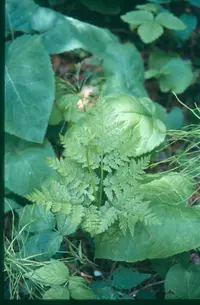
Gentle site marking

Mark the planting site with a subtle tag or stake placed a few inches away so you do not accidentally disturb the crown when the fronds die back and the plant is temporarily invisible.

Minimal root disturbance

Avoid dividing, transplanting, or cultivating the soil close to the plant, since its fleshy roots and underground structures are easily damaged and can cause long-term setbacks or plant loss.

Mycorrhiza-friendly care

Skip broad-spectrum fungicides and avoid high-salt synthetic fertilizers near the root zone to protect the beneficial mycorrhizal fungi that support Botrychium virginianum plant care.

Summer dormancy management

If the fronds yellow and retreat in mid to late summer, reduce watering slightly but keep the soil lightly moist and the area shaded so the underground parts remain healthy and ready to resprout next season.

Common Pests and Diseases

Fern aphids

This pest feeds on tender frond tissues, especially on young, unfolding fronds, causing distortion and pale, sticky patches from honeydew. Symptoms include slowed frond expansion and occasional sooty mold growth on the honeydew deposits.

Solution

Rinse fronds thoroughly with a strong but gentle stream of water to dislodge aphids, repeating every few days as needed. In shaded garden or indoor situations, spot-treat heavy clusters with insecticidal soap or a ready-to-use neem oil spray, making sure to cover undersides of fronds and avoiding application during high heat or strong sun.

Fern scale

These insects attach to stems and frond bases as small, flat or dome-shaped bumps, slowly weakening the plant by sucking sap. Symptoms include yellowing fronds, poor vigor, and a rough, crusty appearance around the lower frond stalks.

Solution

Physically remove visible scales by gently scraping with a fingernail or soft brush, then wipe affected areas with a cloth lightly moistened with diluted alcohol. Follow up with several applications of horticultural oil or neem oil at 7–10 day intervals, focusing on frond bases and protected crevices while monitoring nearby ferns for spread.

Fern rust

This disease appears as small, often orange-brown pustules on the undersides of fronds, which may cause yellowing and premature frond drop. Symptoms include patchy discoloration that spreads along the frond segments over time.

Solution

Prune and discard infected fronds promptly to reduce spore load and avoid overhead watering that leaves foliage wet for long periods. Improve airflow around the plant and, if the problem persists, apply a labeled fungicide for rust on ferns, treating surrounding ferns at the same time to limit reinfection.

Leaf spot

This disease produces round to irregular brown or black spots on fronds, sometimes with a pale halo, that can merge into larger dead patches. Symptoms include thinning foliage, reduced photosynthesis, and in severe cases early dieback of affected fronds.

Solution

Remove and dispose of spotted fronds to reduce pathogen spread, keeping foliage as dry as possible by watering at soil level. In shaded gardens where leaf spot is recurrent, apply a copper-based or other fern-safe fungicide according to label directions, and maintain good spacing and organic mulch to support overall Botrychium virginianum plant care.

Interesting Facts

Seasonally splitting frond

This species produces a single frond that is divided into two distinct parts: a sterile, leafy photosynthetic portion and a fertile, spike-like portion that carries the sporangia where spores are formed.

Hidden underground bodies

Mature plants develop fleshy underground structures that store nutrients and help the fern resprout after the aboveground frond dies back, allowing it to persist for years in the same location.

Forest gap specialist

In its native range, this fern is often most abundant in moist, deciduous forests where small canopy openings allow filtered light, and it frequently appears in rich, undisturbed soils with deep leaf litter.

Botan icon

Did you know?

The gametophytes of this species, which are the small, sexual phase of the life cycle, live entirely below ground and depend on symbiotic mycorrhizal fungi for nutrition, making them rarely visible and difficult to study in the wild.

FAQs about rattlesnake fern

This species spreads slowly by spores and short underground stems. It forms small, scattered clumps rather than large colonies, so it is unlikely to overrun a garden bed under normal conditions.

Grow Healthy Plants with Botan Care

Keep your plants happy and healthy with plant identification, disease detection, and easy care guidance.

Botan plant care app — identify plants on mobile

Explore More Plants