Wind hardening
Expose young plants to gradually stronger wind over 2–3 months so the trunk and petioles thicken and the palm anchors more firmly before facing full coastal or open-site conditions.

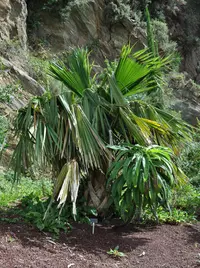
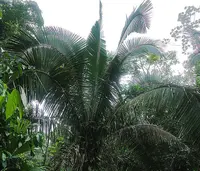
Guadalupe palm, Brahea edulis, is a slow-growing, single-trunk palm native to Guadalupe Island off the coast of Baja California, Mexico. It forms a sturdy, upright silhouette with a dense crown of stiff, fan-shaped leaves. Mature plants can become striking landscape specimens in warm, dry regions.
This species is adapted to arid, coastal climates and tolerates wind and brief drought once established, which makes it relatively low-maintenance outdoors. It prefers full sun, well-drained soil, and moderate watering during active growth. Because of its eventual size and slow pace, most people choose to care for Guadalupe palm in outdoor gardens or large, open spaces rather than small indoor areas.

Care Difficulty
Moderate Care

Light Preference
Full Sun

Water Requirements
Low Water

Temperature Preference
Warm Climate

Hardiness Zone
9–11

Soil Texture
Sandy, Loamy, Rocky

Soil pH
Slightly acidic (6.5–7.0), Slightly alkaline (7.0–7.5)

Soil Drainage
Well-drained

Fertilization
Minimal (feed rarely)
Scan your plant to receive care tips personalized for your specific plant
Available on iOS and Android
This palm prefers bright, open exposures but adapts to slightly less intense conditions.
This drought-tolerant palm prefers deep, infrequent watering once established.
This species thrives in warm, dry climates with mild winters and good heat tolerance.
This species handles low humidity well and rarely needs special humidity management indoors or outdoors.
This palm prefers sharply drained, mineral soils that stay aerated after watering.
This palm can be grown in containers, especially while young, if the pot is chosen to support its deep, eventually heavy root system.
Brahea edulis is a slow-growing palm that benefits from light, steady feeding during the warm growing season.
Brahea edulis needs only modest pruning focused on health and safety, not shaping.
This palm dislikes disturbance, so repotting or transplanting Brahea edulis should be infrequent and carefully planned.
Brahea edulis is generally propagated from seed, which germinates slowly and needs patience and stable warmth.
This palm is moderately cold tolerant but benefits from simple winter care in regions with frost or occasional freezes.

Plant Health Check
Not sure what's wrong with your plant? Check your plant's health inside the app.
This palm is naturally restricted to Guadalupe Island off the Pacific coast of Baja California, where it evolved in isolation and now survives mainly on steep, rocky slopes that goats could not reach.
Introduced feral goats overgrazed Guadalupe Island for more than a century, destroying seedlings and leaving an aging population of Brahea edulis with very limited natural regeneration in the wild.
The fleshy, edible fruits once formed a significant seasonal food source for native birds such as the Guadalupe caracara and other island fauna, linking the palm closely to the island’s former ecological web.

Mature individuals of Brahea edulis can live for several centuries, making old trees surviving on Guadalupe Island living relics from before the arrival of heavy goat grazing and major human disturbance.
Growth is slow, usually 15–30 cm per year in suitable climates. Age, root space, temperature, and water availability strongly influence speed. In marginal climates or small containers it grows even more slowly and may remain compact for years.
Keep your plants happy and healthy with plant identification, disease detection, and easy care guidance.