Optimize mounting
Mount plants on cork or hardwood with a thin pad of long-fiber sphagnum only around the roots, leaving pseudobulbs fully exposed so they dry quickly and resist rot.

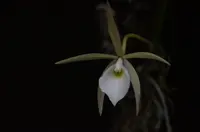
Brassavola tuberculata is a small to medium epiphytic orchid that naturally grows on trees or rocks in warm regions of South America, especially Brazil. It forms clumps of narrow, pencil-like leaves and produces star-shaped, often fragrant flowers that are usually white or pale green with a contrasting lip. The plant prefers bright light, good air movement, and quick-drying roots, which help reduce rot problems. It suits growers who can provide stable warmth and regular, light watering rather than constant moisture. For those learning how to care for Brassavola tuberculata, its resilient nature and compact size make it a manageable orchid once basic needs are understood.

Care Difficulty
Moderate Care

Light Preference
Partial Sun

Water Requirements
Moderate Water

Temperature Preference
Tropical / Frost Sensitive

Hardiness Zone
11–12

Soil Texture
Sandy, Rocky, Organic-rich

Soil pH
Acidic (5.5–6.5)

Soil Drainage
Well-drained

Fertilization
Light (every 4–6 weeks)
Scan your plant to receive care tips personalized for your specific plant
Available on iOS and Android
This orchid prefers bright, indirect light with some direct sun exposure for strong growth and flowering.
Watering should balance thorough soaking with fast drying around the roots.
Stable warm conditions support vigorous growth and reliable flowering.
This orchid prefers moderate to high humidity but adapts to typical indoor levels if airflow is strong.
Brassavola tuberculata grows best mounted or in a very open, bark-based medium rather than dense potting soil.
This species is well-suited to container culture when mounted or grown in small, airy orchid pots.
This orchid benefits from light, consistent feeding during active growth for steady flowering and healthy roots.
Pruning needs are minimal and mainly involve hygiene rather than reshaping this orchid.
This species prefers to stay undisturbed and is usually repotted or remounted only when clearly necessary.
Propagation of this orchid is usually done by division rather than from seed in home conditions.
This warm-growing orchid is frost-sensitive and needs protection anywhere temperatures drop near freezing.

Plant Health Check
Not sure what's wrong with your plant? Check your plant's health inside the app.
This species releases a strong, sweet fragrance mainly at night, an adaptation that targets nocturnal moth pollinators that navigate using scent rather than bright colors.
The lip of the flower has small raised bumps (tubercles), a characteristic feature that helps distinguish this species within Brassavola and is used by taxonomists when identifying herbarium material.
In its native range of Brazil and nearby regions, this orchid often grows both as an epiphyte on tree trunks and as a lithophyte on exposed rocks, showing a notable tolerance for high light and rapid drying of roots.
Lack of blooms often results from insufficient light, too little nightly temperature drop, or inadequate fertilizer. Provide bright, indirect light, a 10–15°F cooler night, and regular but dilute feeding to support reliable flowering when caring for Brassavola tuberculata.
Keep your plants happy and healthy with plant identification, disease detection, and easy care guidance.