flame tree Care (Brownea macrophylla)

flame tree

About flame tree

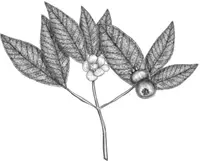
The flame tree Brownea macrophylla is a tropical evergreen tree valued for its dramatic clusters of bright red, bell-shaped flowers. It typically grows with a dense, rounded crown and smooth grayish bark, giving it a sculptural look in gardens and large conservatories.

This species is native to the humid lowland rainforests of Central and South America, where it thrives in warm, sheltered, and consistently moist conditions. In cultivation, it prefers bright filtered light, rich well-drained soil, and protection from cold or strong drying winds.

Due to its slow growth and need for stable warmth and humidity, it is more suited to experienced growers or dedicated enthusiasts. Learning how to care for flame tree before planting helps improve long-term success.

Main Plant Requirements

Care Difficulty

Hard Care

Light Preference

Partial Shade

Water Requirements

Keep Soil Moist

Temperature Preference

Tropical / Frost Sensitive

Hardiness Zone

11–12

Soil Texture

Loamy, Organic-rich

Soil pH

Acidic (5.5–6.5), Slightly acidic (6.5–7.0)

Soil Drainage

Moist but well-drained

Fertilization

Light (every 4–6 weeks)

Get Personalized Care Plan

Scan your plant to receive care tips personalized for your specific plant

Available on iOS and Android

How to Care for the flame tree

This tropical tree prefers bright, gentle light similar to a high-canopy rainforest edge.

  • Provide 3–5 hours of soft morning sun with bright, filtered light the rest of the day; strong afternoon sun can scorch Brownea macrophylla leaves.
  • Allow light dappled shade under taller trees; it tolerates 50–70% shade but flowering may be reduced in very dim sites.
  • In hot summers, give extra shade from 1–4 p.m.; in cooler seasons, ensure more open exposure to maintain compact growth and bud production.

This species needs steadily moist but well-aerated soil, similar to a humid forest floor.

  • Water when the top 3–5 cm of soil feel slightly dry yet deeper soil still feels cool and moist, aiming to avoid both dust-dry and soggy conditions.
  • Use deep, slow watering so moisture reaches 20–30 cm depth, and ensure soil drains freely; persistent puddling or foul smell indicates poor drainage and overwatering risk.
  • In cooler months reduce frequency as growth slows; wilting, crisp leaf edges, and curling tips suggest underwatering, while yellowing leaves and dieback suggest overwatering.

This lowland tropical tree thrives in consistently warm, frost-free conditions.

  • Aim for 70–85°F (21–29°C) for strong growth; flowering is best where night temperatures stay above 65°F (18°C).
  • Protect it from cold; growth stops below about 55°F (13°C), foliage can be damaged near 40°F (4°C), and any frost can kill young shoots.
  • It tolerates short heat waves up to about 95°F (35°C) if soil moisture and humidity stay high, but hot, dry winds increase leaf scorch risk.

This species prefers consistently humid air to maintain healthy foliage and flowering.

  • Aim for 60–80% humidity, which reflects its native tropical understory conditions.
  • Tolerates short periods of drier indoor air, but prolonged levels below 40% cause leaf-edge browning and tip dieback.
  • Increase humidity with a nearby humidifier, grouped plants, or an evaporative pebble tray rather than frequent misting, which offers only brief benefit.

Soil for Brownea macrophylla must be moist yet free-draining to protect its fine roots from suffocation and rot.

  • Use a rich, loamy mix combining roughly 50% organic matter (composted bark or leaf mold), 30% coarse material (perlite or pumice), and 20% standard potting soil.
  • Ensure rapid drainage by avoiding heavy clay and peat-only mixes, which compact and hold water around the roots for too long.
  • Target a slightly acidic to neutral pH around 6.0–7.0, amending alkaline soil with extra composted bark or leaf mold to buffer pH.
  • Improve aeration further by mixing in chunky bark or coarse perlite so water moves through quickly but the root zone stays evenly moist.

This species can be grown in containers when young or kept smaller under controlled conditions.

  • Choose a deep, wide container that allows a spreading root system and reduces tipping as the canopy becomes dense and heavy.
  • Use a heavy, stable pot material such as ceramic to counterbalance the top growth and limit wind-related movement.
  • Raise the container slightly on feet or spacers so drainage holes stay clear and water cannot pool under the base.

Brownea macrophylla benefits from modest, consistent feeding to support foliage and flower production.

  • Use a balanced, slow-release fertilizer (around 10-10-10) or well-rotted compost mixed into the topsoil at the start of the warm growing season.
  • Feed every 6–8 weeks during active growth, adjusting for soil richness and plant vigor.
  • Apply at half the label rate for container plants to avoid root burn and excess salt buildup.
  • In cooler months or when growth slows, pause or greatly reduce feeding as the flame tree uses fewer nutrients.

Pruning Brownea macrophylla is mainly done to maintain structure and remove weak growth rather than to control size heavily.

  • Plan light structural pruning after main flowering has finished so flower buds are not removed beforehand.
  • Remove dead, diseased, crossing, or inward-growing branches using sharp, clean bypass pruners or loppers.
  • Thin congested interior shoots slightly to improve airflow and light penetration, which supports healthier growth.
  • Limit cuts to smaller branches, maintaining the natural umbrella form and avoiding heavy topping that can stress the tree.

Brownea macrophylla is usually grown in the ground, so transplanting young trees correctly is more important than frequent repotting.

  • Look for roots circling the pot, water running straight through, or slowed growth as signs a nursery plant is ready to move up a size or into the ground.
  • Plan transplanting for warm, frost-free periods, typically spring to early summer, to allow strong root establishment.
  • Move container plants every 2–3 years into a pot 1–2 in wider with free-draining, rich soil, gently loosening circling roots.
  • Water thoroughly after transplanting, shade the plant for 1–2 weeks, and keep soil evenly moist to reduce transplant shock and root stress.

Propagation of Brownea macrophylla is possible but relatively slow and is usually done by seed or semi-hardwood cuttings.

  • Sow fresh seeds in warm conditions around 75–80°F in a sterile, well-drained mix and keep lightly moist until germination.
  • Take semi-hardwood cuttings in late spring or early summer, 10–15 cm long, with 2–3 nodes and minimal leaves.
  • Use a rooting hormone, place cuttings in a humid environment with bright, indirect light, and bottom heat if possible.
  • Expect gradual rooting and keep media just moist, avoiding waterlogging that encourages rot.

This tropical species needs careful winter management in climates with cool or freezing conditions.

  • In ground, it is suitable only for frost-free or nearly frost-free areas; even light freezes can damage foliage and young wood.
  • Apply a 5–8 cm mulch layer over the root zone in late fall, keeping it slightly away from the trunk to moderate soil temperature.
  • For container plants in cooler climates, move indoors or into a heated greenhouse before temperatures drop below 50°F.
  • Provide bright, filtered light indoors and reduce watering slightly so the root zone stays just barely moist during the coolest months.

Care Tips

Wind protection planning

Site young trees where buildings, hedges, or temporary windbreak fabric reduce strong prevailing winds, as Brownea macrophylla has brittle branches that can snap under repeated mechanical stress.

Low-branch structure

Allow several low scaffold branches to develop instead of a bare trunk, since a broad, low framework supports heavy flower clusters and reduces the risk of limb failure as the canopy gains weight.

Mulch moisture buffer

Maintain a 5–8 cm ring of coarse organic mulch over the root zone, kept a few cm away from the trunk, to stabilize soil moisture and temperature and protect shallow feeder roots from compaction.

Root zone protection

Avoid frequent foot traffic, paving, or heavy containers over the root area, as compacted soil around this species quickly reduces oxygen to roots and slows growth.

Cold event strategy

Before forecast cold snaps, water the soil thoroughly and wrap the lower trunk with horticultural fleece or burlap, which together reduce cold shock and bark damage in marginal climates when growing flame tree.

Common Pests and Diseases

Scale insects

This pest attaches to young stems and leaf undersides, sucking sap and causing yellowing, sticky honeydew, and sooty mold growth.

Solution

Prune out heavily infested twigs, then wipe or gently scrub remaining colonies off with a cloth dipped in diluted insecticidal soap or horticultural oil, repeating every 7–10 days until new growth remains clean. Reduce plant stress with consistent watering and good light, and avoid high-nitrogen fertilizer that encourages soft, scale-prone growth when planning Brownea macrophylla plant care.

Mealybugs

These insects form white, cottony clusters in leaf axils and on new shoots, leading to distorted growth, leaf drop, and sticky honeydew that can attract ants.

Solution

Isolate the plant, then remove visible clusters with a cotton swab dipped in isopropyl alcohol and follow with thorough sprays of insecticidal soap on all leaf surfaces and crevices. Repeat treatments weekly until no new insects appear and improve air movement around the canopy to discourage reinfestation.

Leaf spot

This disease causes circular to irregular brown or purplish lesions on leaf blades, sometimes with yellow halos and premature leaf shedding during humid, warm periods.

Solution

Remove and dispose of affected leaves, avoid overhead watering, and keep foliage as dry as possible, especially at night. In persistently wet climates, apply a copper-based or chlorothalonil fungicide according to label directions at the first sign of spotting to protect new leaves.

Anthracnose

This disease produces dark, sunken lesions along leaf veins and young shoots, often leading to dieback of tender growth during extended periods of high humidity and poor air circulation.

Solution

Prune and destroy infected shoots, improve airflow by thinning crowded branches, and keep the canopy dry by watering at soil level. In areas with repeated outbreaks, protect flushing growth with periodic applications of a registered ornamental fungicide labeled for anthracnose, following all safety and timing instructions.

Interesting Facts

Pendant pompom inflorescences

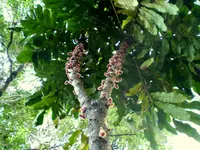
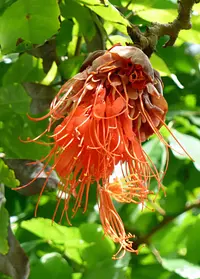
This species produces dense, spherical clusters of bright red flowers that hang on long, flexible stalks, giving the appearance of floral pompoms suspended beneath the branches.

Large, soft juvenile leaves

New leaves emerge in long, drooping flushes that are pink to bronze and very soft, only hardening and turning green as they mature, a common adaptation in some rainforest trees to reduce herbivore damage and sun stress.

Understory rainforest tree

In its native range of lowland Neotropical rainforests, this tree typically grows in the shaded understory and along stream banks, adapted to warm, humid conditions with filtered light rather than full, open sun.

Botan icon

Did you know?

The showy, nectar-rich flowers of this species are primarily pollinated by hummingbirds in its native Neotropical habitats, relying on these birds’ specialized hovering and long beaks to transfer pollen between the hanging flower clusters.

FAQs about flame tree

Lack of flowering usually results from insufficient maturity, inadequate light intensity, or heavy nitrogen fertilization. Cool spells, drought stress, or recent repotting/pruning can also delay buds. Stable warmth, balanced fertilizer, and patience often restore normal blooming.

Grow Healthy Plants with Botan Care

Keep your plants happy and healthy with plant identification, disease detection, and easy care guidance.

Botan plant care app — identify plants on mobile

Explore More Plants