Mulch For Roots
Apply a 3–5 cm layer of fine bark mulch around the crown each spring to keep roots cool, conserve moisture, and reduce weed competition without burying the crown itself.

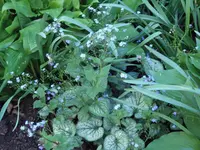
Silver Siberian bugloss, Brunnera macrophylla 'Jack Frost', is a shade-loving perennial grown mainly for its striking foliage. It forms low, dense clumps that slowly expand to create a textured groundcover in cool, sheltered spots.
Its heart-shaped leaves are silvery with green veins, giving a frosted look that stands out in dim light. In spring, it produces small blue flowers that resemble forget-me-nots on airy stems above the foliage.
This plant is native to woodland regions of Eastern Europe, which explains its preference for cool conditions, filtered light, and consistently moist, humus-rich soil. Understanding this woodland background makes it easier to care for Silver Siberian bugloss in typical garden settings.

Care Difficulty
Moderate Care

Light Preference
Partial Shade

Water Requirements
Regular Water

Temperature Preference
Cold Hardy

Hardiness Zone
3–8

Soil Texture
Loamy, Silty, Organic-rich

Soil pH
Acidic (5.5–6.5), Slightly acidic (6.5–7.0)

Soil Drainage
Moist but well-drained

Fertilization
Minimal (feed rarely)
Scan your plant to receive care tips personalized for your specific plant
Available on iOS and Android
Brunnera macrophylla 'Jack Frost' prefers cool, shaded conditions that protect its foliage from strong sun.
Brunnera macrophylla 'Jack Frost' prefers consistently moist but not waterlogged soil, especially during active growth.
This plant is a cool-climate perennial that tolerates winter cold well but dislikes prolonged heat.
This shade perennial prefers moderately moist air but usually copes well with typical outdoor humidity.
This plant grows best in consistently moist, humus-rich, well-aerated soil.
This species is suitable for cool, shaded container displays outdoors.
Brunnera macrophylla 'Jack Frost' benefits from light feeding to support foliage and flowering but does not need heavy fertilization.
Pruning Brunnera macrophylla 'Jack Frost' is straightforward and focuses on tidiness rather than shaping.
Transplanting Brunnera macrophylla 'Jack Frost' is usually needed only when clumps outgrow their space or performance declines.
Brunnera macrophylla 'Jack Frost' is most reliably propagated by division rather than seeds or cuttings.
Brunnera macrophylla 'Jack Frost' is generally cold hardy and needs only modest winter care in most temperate climates.

Plant Health Check
Not sure what's wrong with your plant? Check your plant's health inside the app.
The silver marbling on the leaves comes from air-filled spaces in the leaf tissue that scatter light, creating a pale, metallic look without needing true pigment. This stable variegation is genetically fixed in the cultivar, so it stays consistent year after year under normal garden conditions.
This plant was selected from forms of Brunnera macrophylla that evolved in moist, shaded woodlands from Eastern Europe to Western Asia, which explains its strong performance in low-light garden settings. The large, heart-shaped leaves maximize surface area for light capture under tree canopies.
Its small, blue, forget-me-not-like flowers typically appear before many summer perennials leaf out fully, helping it fill an early-season color gap in shade borders. Flowering often overlaps with emerging bulbs like daffodils and tulips, making it a common choice in layered woodland-style plantings.

Jack Frost arose as a chance sport, or spontaneous mutation, discovered in a nursery setting, and was later propagated clonally, meaning that all plants sold under this name are essentially genetically identical copies of that original, unusually silver-marked plant.
This species forms slowly expanding clumps through short rhizomes. It can gently self-seed in suitable conditions but is not considered aggressive. Occasional division or removal of unwanted seedlings keeps it neatly contained in mixed borders or shade beds.
Keep your plants happy and healthy with plant identification, disease detection, and easy care guidance.