Mounting strategy
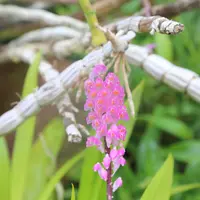
Use cork bark or a slatted basket with a thin pad of long-fiber sphagnum so roots can attach firmly while still drying quickly between waterings, and secure new growths loosely with soft wire or clips until they anchor.

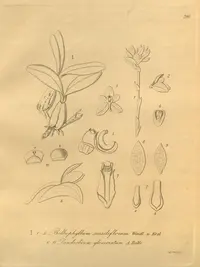
Bulbophyllum molossus is a small epiphytic orchid that typically grows on trees, forming compact clumps of pseudobulbs with narrow leaves. It produces distinctive, often strongly scented flowers that can appear in clusters close to the plant.
This species occurs naturally in tropical regions of Southeast Asia, where it experiences warm, humid, and shaded forest conditions. Its need for consistent moisture, good air movement, and stable warmth can make care for Bulbophyllum molossus more challenging for beginners.
The plant prefers bright, filtered light and quick-drying yet evenly moist growing media, such as fine bark or sphagnum on a mount or in a small pot.

Care Difficulty
Hard Care

Light Preference
Bright Indirect Light

Water Requirements
Keep Soil Moist

Temperature Preference
Tropical / Frost Sensitive

Hardiness Zone
Unknown

Soil Texture
Peaty, Organic-rich, Rocky

Soil pH
Acidic (5.5–6.5)

Soil Drainage
Moist but well-drained

Fertilization
Light (every 4–6 weeks)
Scan your plant to receive care tips personalized for your specific plant
Available on iOS and Android
This orchid prefers bright, filtered light that mimics dappled forest shade.
Watering should keep roots moist but never stagnant.
This species grows best in consistently warm, stable temperatures.
This orchid requires consistently high humidity to grow well indoors or in a greenhouse.
Bulbophyllum molossus grows best in a very airy, moisture-retentive, organic-based orchid medium rather than standard potting soil.
This species is well suited to container culture, especially in shallow orchid pots or baskets.
This orchid benefits from light, consistent feeding rather than heavy applications.
Bulbophyllum molossus needs only minimal pruning focused on hygiene and maintaining plant health.
This species prefers stable conditions, so repotting should be infrequent and done with care.
Propagation of this orchid is usually done by careful division rather than from seed.
This warmth-loving orchid is not frost tolerant and needs sheltered conditions in winter.

Plant Health Check
Not sure what's wrong with your plant? Check your plant's health inside the app.
Its flowers produce a strong odor reminiscent of decaying organic material, an adaptation that attracts fly pollinators instead of bees or butterflies.
The dark, often mottled flower parts and fleshy textures mimic decomposing matter, guiding saprophagous flies to contact the pollinia and complete pollination.
This species typically grows as an epiphyte on tree trunks and branches in humid tropical forests, anchoring to bark rather than soil and absorbing moisture and nutrients from rain and organic debris.
This species usually flowers once a year, often in the warmer, humid season, though timing varies by growing conditions. Mature, well-established plants may produce several inflorescences in a season, each carrying multiple small flowers.
Keep your plants happy and healthy with plant identification, disease detection, and easy care guidance.