
American beautyberry Identification (Callicarpa americana)

Recognize American beautyberry by its opposite, oval leaves with pointed tips and coarse teeth, paired along arching stems.

It usually grows as a many-stemmed shrub about 3 to 6 feet (0.9 to 1.8 m) tall, with small flower or fruit clusters packed tightly at the leaf nodes around the stems.

Callicarpa americana Identification

Check Your Plant ID

Upload a clear photo to check your plant identification with Botan.

Clear images work best. Avoid photos taken too close or too far away

  • 1 free identification
  • No sign-up
  • 30,000+ plants in database

Check the stem pattern, leaf layout, and berry clusters of Callicarpa americana.

  • A loose, arching shrub, often 3 to 8 feet (0.9 to 2.4 m) tall, with many slender branches.
  • Leaves grow in opposite pairs along the stems and are simple, oval to elliptic, about 3 to 6 inches (8 to 15 cm) long.
  • Leaf edges are toothed, especially from the middle toward the tip, and the underside is usually paler.
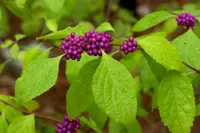
  • Small round berries sit in tight clusters that wrap around the stems at the leaf nodes.

The paired leaves plus stem-hugging berry clusters are especially useful visible clues.

Callicarpa americana shows clear visual shifts from youth through flowering and especially fruiting.

  • Young plant: Young plants are upright and loosely branched, with opposite leaves already broad and serrated, but stems stay slender and the rounded shrub form is not established.
  • Mature plant: Mature plants develop an arching, multi-stemmed shrub shape, often 3-6 feet (0.9-1.8 m) tall, with longer lateral branches and a wider, fountain-like outline.
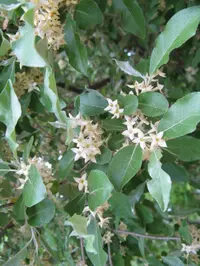
  • Flowering stage: Small pale pink to lavender flowers appear in tight clusters at the leaf axils, circling the stems instead of forming terminal flower spikes.
  • Fruiting stage: Fruiting plants are easiest to recognize by dense, bright purple berry clusters packed closely around the stems where flowers had formed.

In spring, American beautyberry leafs out with opposite, bright green leaves on arching stems. By early summer, small pale pink to lavender flower clusters become visible at the leaf nodes, where leaves join the stem. By late summer into fall, tight rings of vivid purple berries make it easy to recognize. After leaf drop, the bare arching stems and berry clusters may remain visible for a time.

A few beautyberries can be mistaken for American beautyberry at a glance.

Japanese beautyberry(Callicarpa japonica)

Often confused because both are arching shrubs with tight clusters of purple berries. Japanese beautyberry usually has smaller leaves and berries borne on noticeably longer stalks, so the fruit clusters sit a little away from the stem instead of hugging it closely.

Bodinier's beautyberry(Callicarpa bodinieri)

Similar for its purple berry clusters along the stems. It is often more upright, and the leaves are typically narrower with a longer tapered tip than the broader, more coarsely toothed leaves of C. americana.

Callicarpa americana is native to the southeastern United States, from Virginia to Florida and west to Texas and Oklahoma. It is most often found in open woods, woodland edges, thickets, and streambanks. This range and habitat help separate it from similar beautyberries that are native to East Asia or are less tied to the Southeast.

Scan. Check. Confirm.

Use Botan to identify or verify a plant from a photo when you want a quicker, more confident answer.

FAQ

The quickest check is the fruit. This species carries tight clusters of bright purple berries wrapped around the stem at the leaf nodes, rather than berries on long branching stalks. That pattern is central to identifying American beautyberry.

More Plant Identification Guides

Find Out What Plant It Is

Use Botan to identify a plant from a photo, then review plant details, care information, and common problems.

Botan app identifying a plant from a photo
12 Best Cold-Hardy Vegetables for Cold Weather

7 min read · 13 Oct 2026

12 Best Cold-Hardy Vegetables for Cold Weather

Cold-hardy vegetables can keep a garden productive through chilly fall, winter, and early spring weather. This guide covers 12 reliable crops, their frost tolerance, and practical growing tips for better cold-season harvests.

Plant Recommendations
12 Best Cold-Hardy Vegetables for Cold Weather
When to Harvest Carrots: Timing, Signs, and How to Pick Them

6 min read · 23 Oct 2026

When to Harvest Carrots: Timing, Signs, and How to Pick Them

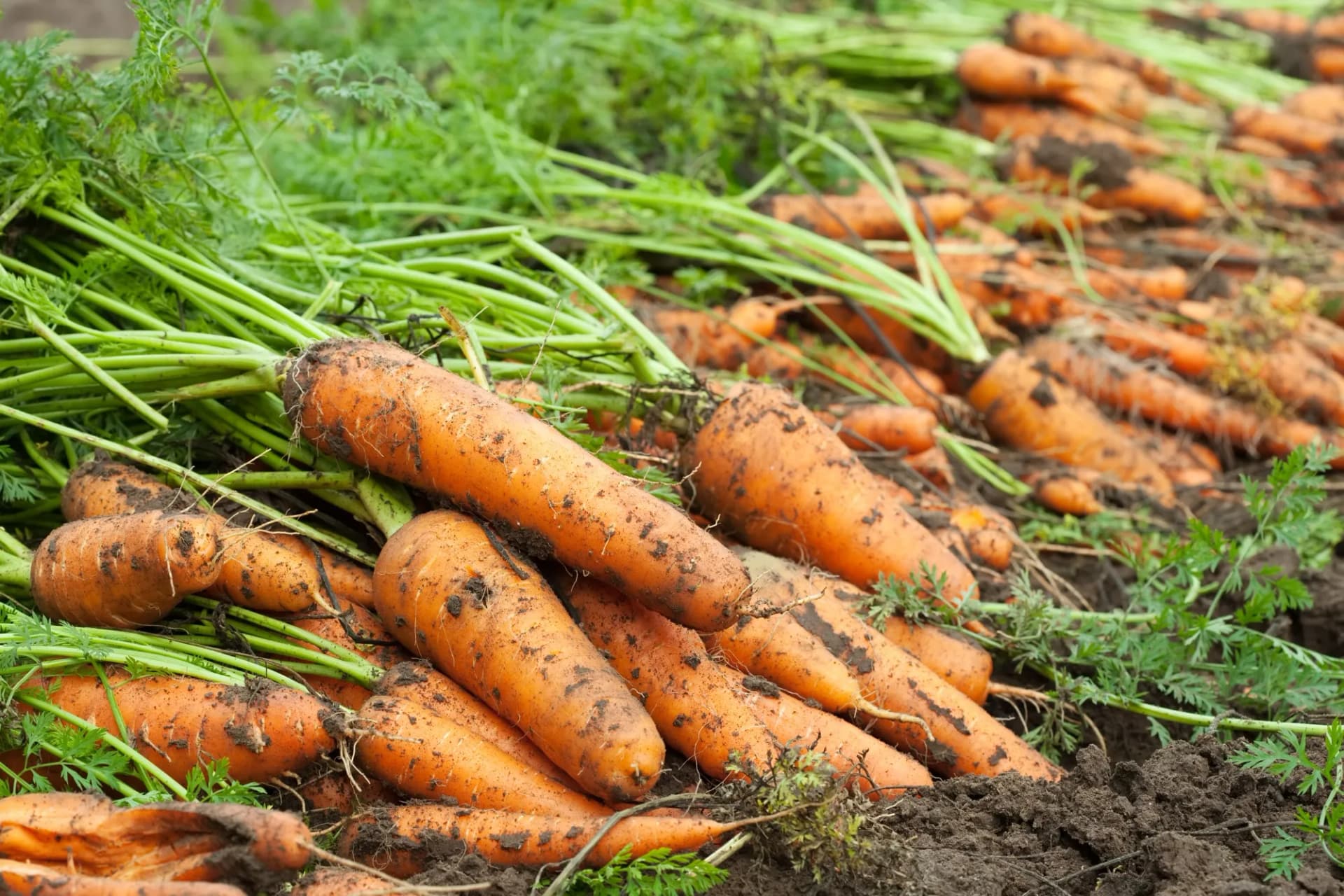
Carrots are usually ready 60-80 days after sowing them in the soil, depending on the variety. Learn how to recognize maturity signs, choose the right harvest season, pull carrots without damaging them, and store roots after picking.

Plant Care
When to Harvest Carrots: Timing, Signs, and How to Pick Them
What Do Plants Need to Grow – 5 Things Every Greenery Can't Live Without

8 min read · 31 Jul 2026

What Do Plants Need to Grow – 5 Things Every Greenery Can't Live Without

To keep plants healthy and thriving, provide the right balance of light, humidity, nutrients, airflow, and quality soil. This guide covers the essentials of year-round plant care.

Beginner Guides
What Do Plants Need to Grow – 5 Things Every Greenery Can't Live Without