


Maintain Water Movement
Provide gentle water circulation with a small pump or filter to keep oxygen levels stable and prevent debris from settling on the foliage, but avoid strong currents that uproot the plant mats.


Pond water-starwort (Callitriche stagnalis) is a small, aquatic plant commonly found in ponds, ditches, and slow-moving streams. It forms low, green mats that float on or just below the water surface. Leaves are tiny and often form star-like rosettes, giving the plant a fine, delicate look. In shallow water it can root in mud, while in deeper water it may float freely. This species spreads quickly and can cover calm water bodies under the right conditions. It prefers clean, cool, well-oxygenated water and steady moisture. Once established, it is generally easy to maintain, and basic knowledge of how to care for pond water-starwort helps prevent overgrowth.

Care Difficulty
Moderate Care

Light Preference
Partial Sun

Water Requirements
Aquatic

Temperature Preference
Cool Climate

Hardiness Zone
5–10

Soil Texture
Loamy, Silty, Organic-rich

Soil pH
Slightly acidic (6.5–7.0), Neutral (7.0)

Soil Drainage
Waterlogged tolerant

Fertilization
Minimal (feed rarely)
Scan your plant to receive care tips personalized for your specific plant
Available on iOS and Android
This aquatic species prefers bright, gentle light rather than intense, drying sun.
This plant is fully aquatic and depends on stable, clean, oxygenated water rather than traditional soil watering.
This aquatic plant is cool-tolerant but grows best in moderately warm water.
This aquatic species needs constant high humidity and thrives fully or partially submerged.
This species grows best in soft, fine substrates that stay saturated but not anaerobic.
This plant is suitable for container culture in ponds, tubs, or aquaria when water level and substrate are controlled carefully.
This aquatic species usually takes what it needs from nutrient-rich water, so heavy feeding is unnecessary for caring for pond water-starwort.
Pruning helps keep Callitriche stagnalis dense, healthy, and within bounds in managed ponds or aquariums.
This plant is usually grown loose or in baskets, so focus on transplanting clumps rather than classic repotting.
New plants are commonly produced from vegetative fragments rather than seed in Callitriche stagnalis.
This species is quite cold hardy in ponds and usually needs little special winter care in temperate climates.

Plant Health Check
Not sure what's wrong with your plant? Check your plant's health inside the app.
This species can live fully submerged or as a small rosette at the water surface, shifting its leaf shape and arrangement depending on water depth and flow.
It often colonizes nutrient-rich, slow-moving waters and can be used as a bioindicator, since dense growth may signal elevated nutrient levels and reduced water quality.
The plant produces very small, flattened fruits that split into four nutlets, which are easily spread by water movement and waterfowl, aiding rapid colonization of ponds and ditches.

In several regions outside its native range, this species is considered invasive in waterways, where its dense mats can outcompete local aquatic plants and alter habitat conditions for invertebrates and small fish.
Yellowing foliage often indicates nutrient deficiency, especially nitrogen or iron, or poor water quality with low oxygen. Check for excessive shade, accumulated debris, or high ammonia levels, and improve filtration and water changes to stabilize conditions.
Keep your plants happy and healthy with plant identification, disease detection, and easy care guidance.

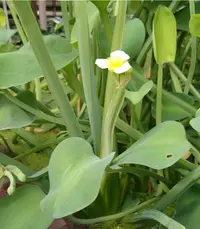
yellow velvetleaf
Limnocharis flava
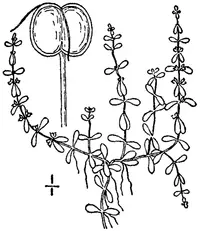
terrestrial water-starwort
Callitriche terrestris
Umbrella Flat-Sedge
Cyperus alterniflorus
Pedunculate Water-Starwort
Callitriche brutia
Bog Arum
Calla palustris
winged water-starwort
Callitriche marginata
Indian swampweed
Hygrophila polysperma
Intermediate Water-Starwort
Callitriche hamulata